How Much Does Foundation Repair Cost in 2026?
By Koray Bozkurt, PE, PMP, BOZ Engineering Group. Last updated June 2026.
A hairline crack in the basement wall doesn’t always mean disaster, but it doesn’t always mean nothing either. That’s the tension every DMV homeowner faces when they first spot a problem. You want a number. You want to know whether you’re looking at a few hundred dollars of epoxy or a five-figure underpinning project. And the honest answer is that foundation repair cost swings across an enormous range depending on what’s actually wrong.
Here’s the good news. Once you understand what drives the price, the range stops feeling random. Repair method, foundation type, soil conditions, access, and the extent of the movement all push the number up or down in predictable ways. This guide breaks down what foundation repair costs in 2026, method by method and severity by severity, and explains why the smartest first dollar you spend often goes to a structural or geotechnical engineer, not a repair crew.
Key Takeaways
- The national average foundation repair runs about $5,176, with most projects landing between $2,225 and $8,135 (Angi, 2026).
- Minor crack injection can cost as little as $250 to $800, while full underpinning with piers can reach $20,000 or more.
- DMV soils matter. Expansive clays across Virginia’s Piedmont and Coastal Plain can generate swelling pressures over 30,000 pounds per square foot (Virginia Energy).
- An independent engineer’s diagnosis should come before any repair contractor’s quote so you pay to fix the actual cause, not the symptom.
How much does foundation repair cost on average in 2026?
The national average foundation repair costs about $5,176, and most homeowners spend between $2,225 and $8,135 (Angi, 2026). That band covers the majority of typical residential jobs, but it hides real extremes. A single crack seal costs a few hundred dollars, and a full underpinning of a settling house can run past $30,000.
Why such a wide spread? Because “foundation repair” describes everything from cosmetic patching to lifting an entire structure back onto stable soil. The number on your estimate depends far less on your zip code than on what your foundation is actually doing. A sinking corner, a bowing wall, and a leaking crack are three different problems with three different price tags. Group them together and the “average” tells you almost nothing about your house.
That’s exactly why a diagnosis has to come first. Two contractors can look at the same crack and propose wildly different scopes, one recommending a $600 injection and the other pitching a $25,000 pier system. Without an engineer’s read on the root cause, you have no way to know which one is right.
How much does foundation repair cost by method?
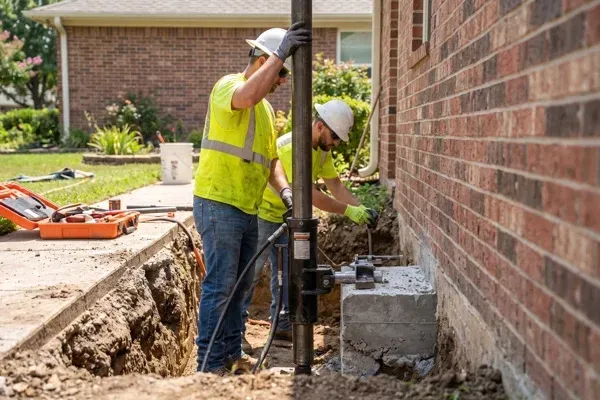
Repair method is the single biggest driver of cost. Crack injection sits at the low end because it treats a symptom without moving the structure. Piering and underpinning sit at the high end because they physically stabilize or lift the foundation on new load-bearing supports. Here’s how the common methods compare, drawing on 2026 national pricing from Angi and HomeAdvisor.
| Repair Method | Typical Cost Range (2026) | What It Fixes |
|---|---|---|
| Crack injection (epoxy/polyurethane) | $250 to $800 per crack | Non-structural cracks, seepage |
| Slab jacking / mudjacking | $600 to $1,600 | Settled concrete slabs, uneven floors |
| Foam jacking (polyurethane) | $2,000 to $5,000 | Larger settled slab areas |
| Wall anchors | $400 to $700 per anchor | Bowing or leaning walls |
| Carbon fiber straps | $350 to $1,000 per strap | Early-stage bowing walls |
| Piering / underpinning | $1,000 to $3,000 per pier | Sinking, settling foundations |
Sources: Angi (2026), HomeAdvisor (2025), Angi bowing wall data (2026).
Most homes needing piers require somewhere between 6 and 12 of them, which pushes a full piering job into the $6,000 to $36,000 territory depending on pier type and count (HomeAdvisor, 2025). A bowing wall stabilized with anchors placed every five feet along a 20-foot wall lands closer to $1,600 to $2,800 (Angi, 2026). The method you need is a structural question, not a shopping preference, which is the whole point of getting a diagnosis first.
Why is crack injection so much cheaper than piering?
Crack injection is cheaper because it seals an existing crack without addressing whatever moved the foundation. Minor cracks run just $250 to $800 with epoxy or polyurethane (Angi, 2026). Piering costs more because it installs new deep supports that carry the structure’s load down to stable soil or bedrock.
The distinction matters enormously. If a crack is purely cosmetic, from concrete curing or minor shrinkage, injection is a perfectly appropriate and affordable fix. But if that same crack is a symptom of ongoing settlement, injecting it just paints over the problem. The wall keeps moving, the crack reopens, and you’ve spent money buying time instead of a solution. Only a structural assessment can tell the two situations apart.
How much does foundation repair cost by severity?
Severity scales the price in a way most homeowners underestimate. A minor issue caught early might cost a few hundred dollars. That same underlying movement, left for a few seasons of DMV freeze-thaw and clay swelling, can escalate into a major structural project costing tens of thousands. Early diagnosis is the cheapest lever you have.
| Severity | Typical Symptoms | Estimated Cost Range |
|---|---|---|
| Minor | Hairline cracks, minor seepage | $250 to $1,500 |
| Moderate | Wider cracks, sticking doors, uneven floors | $2,200 to $8,100 |
| Major | Sinking foundation, significant bowing | $10,000 to $30,000+ |
| Severe / full underpinning | Widespread settlement, structural failure | $20,000 to $80,000 |
Sources: Angi (2026), HomeAdvisor (2025).
The gap between “moderate” and “major” is where most of the financial pain lives. A moderate problem addressed promptly stays inside the $2,225 to $8,135 average band (Angi, 2026). Ignore the warning signs, and you can slide into the $20,000-plus underpinning range. If you’re not sure which signs are urgent, our guide to the warning signs of foundation problems walks through what deserves a same-week call versus what can wait.
What drives foundation repair cost up or down?
Beyond method and severity, four factors move the number the most: foundation type, access, soil conditions, and the extent of the damage. A poured slab repair can range from a few hundred dollars up to $20,000, while crawl space and pier-and-beam systems can hit $25,000 in extreme cases (HomeAdvisor, 2025).
Foundation type sets the baseline. Slab-on-grade, basement, and crawl space foundations each carry different repair approaches and different labor. Access matters more than people expect. If a crew has to dig around a finished patio, mature landscaping, or a tight urban lot common in DC rowhouses, excavation costs climb. Soil conditions can be the biggest wildcard of all, especially here. And the extent of the damage, meaning how many piers, how many feet of wall, how much of the slab, multiplies everything else. Isn’t it worth knowing which of these applies to your house before you sign anything?
How do DMV soils and older homes affect the cost?
Local geology is a genuine cost driver in the DMV. Much of Virginia’s Piedmont, Coastal Plain, and the Culpeper and Richmond basins sit on expansive clays that can swell up to fifteen times their dry volume and exert pressures above 30,000 pounds per square foot (Virginia Energy). That relentless shrink-swell cycle drives cracking and settlement across the region.
Northern Virginia’s marine clays are especially notorious, and parts of Chesterfield County have seen real damage in neighborhoods built over expansive soil (Virginia Energy). Add in the DMV’s stock of older homes, many built before modern drainage and soil-prep standards, and you get foundations that were never designed for the ground they sit on. When clay is the culprit, the fix often has to address drainage and soil behavior, not just the crack, which is why a geotechnical read on the soil is so valuable before repair.
Why should an engineer diagnose the problem before you hire a contractor?
Because a repair contractor sells repairs, and an independent engineer sells a diagnosis. That difference protects your wallet. A structural or geotechnical engineer evaluates the root cause, whether it’s soil movement, drainage, or a genuine structural defect, and specifies only what the house actually needs. You then take that objective scope to contractors for bids.
Skipping this step is how homeowners end up overpaying. When your only advisor is the company that profits from the biggest possible job, you have no neutral check on scope. An engineer’s report gives you that check, and it usually costs a small fraction of the repair itself. See our breakdown of what a structural engineer costs to weigh that upfront fee against a five-figure repair. If you’re buying, a structural inspection before you close can surface these issues while you still have negotiating room.
One more reason to document the problem properly: insurance. Coverage for foundation damage is narrow and depends heavily on the cause, and a clear engineering report can make or break a claim. Our guide on whether home insurance covers foundation repair covers what typically qualifies.
Request a foundation assessment and get an independent engineering opinion before you commit to any repair scope.
Frequently Asked Questions
How much does foundation repair cost on average?
The national average is about $5,176, with most homeowners spending between $2,225 and $8,135 (Angi, 2026). Your actual cost depends on foundation type, damage severity, and repair method, so the average is a starting reference, not a quote for your specific situation.
Is foundation repair covered by homeowners insurance?
It depends heavily on the cause. Most policies exclude damage from gradual settlement, expansive soil movement, and poor maintenance, while sudden covered events may qualify. Because coverage is so cause-specific, a documented engineering diagnosis helps. Our insurance guide explains what usually does and doesn’t qualify.
How much does it cost to fix a bowing basement wall?
Bowing wall repair typically runs $500 to $10,000, with a national average near $4,500 (Angi, 2026). Wall anchors cost $400 to $700 each placed every five feet, while carbon fiber straps suit early-stage bowing. Expansive DMV clays make this a common local repair.
Can small foundation cracks be repaired cheaply?
Yes, if they’re truly non-structural. Minor crack injection with epoxy or polyurethane costs just $250 to $800 per crack (Angi, 2026). The catch is that some hairline cracks signal active settlement, so an engineer should confirm the crack is cosmetic before you settle for the cheap fix.
How do I know if I need piers or just a crack repair?
Only a structural assessment can tell you. Piering costs $1,000 to $3,000 per pier and addresses active sinking, while injection just seals cracks (HomeAdvisor, 2025). An independent engineer evaluates whether the foundation is still moving, which determines whether you need structural support or a simple seal.
Koray Bozkurt, PE, PMP, is the founder and principal engineer of BOZ Engineering Group, a full-service firm licensed in DC, Maryland, Virginia, and Florida. He holds a master’s degree in geotechnical engineering and brings more than 18 years of structural design experience to residential and commercial projects across the DMV.