
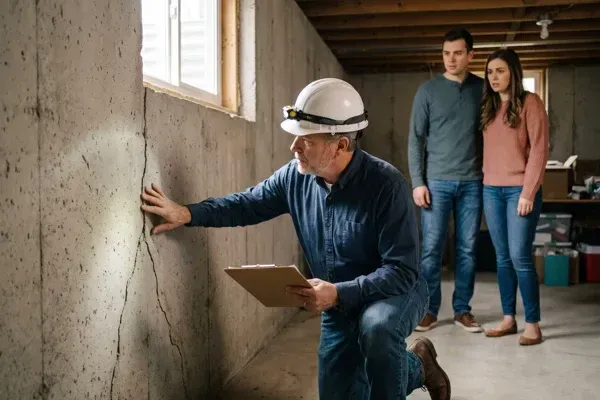
Do You Need a Structural Inspection Before Buying a House?
By Koray Bozkurt, PE, PMP, BOZ Engineering Group. Last updated June 2026.
You found the house. The offer’s in, the general home inspection is done, and then you hit a line in the report that stops you cold: “Recommend evaluation by a licensed structural engineer.” If your stomach dropped a little, that’s normal. But that sentence isn’t a death sentence for the deal. It’s a signal that a generalist spotted something outside their lane and wants a specialist to weigh in.
That specialist is a structural engineer, and the focused review they perform is called a structural inspection. In the DC, Maryland, and Virginia market, where a huge share of the housing stock predates 1980, this handoff happens more often than buyers expect. The median owner-occupied home in the U.S. is now 42 years old (National Association of Home Builders analysis of the 2024 American Community Survey, 2024), and the DMV skews older still. This post walks through when you actually need a structural engineer inspection before buying, what the engineer checks, the red flags that trigger the call, what it costs, and how that report becomes leverage at the negotiating table.
Key Takeaways
- A standard home inspection and a structural engineer inspection are not the same thing. The first is a broad visual scan; the second is an engineering evaluation of load paths and soil behavior.
- Roughly 77% of buyers still get a home inspection (National Association of REALTORS®, 2025), and a fraction of those get referred on to a structural engineer for a focused second look.
- A residential structural inspection typically runs a few hundred dollars, while an unaddressed foundation problem can average around $5,100 to fix (HomeAdvisor, 2025).
- A stamped engineering report gives you a professional, defensible basis to renegotiate price, request repairs, or walk away.
Do you actually need a structural inspection before buying?
Not for every house. You need a structural engineer inspection when your home inspector flags something specific, when the property is old or has a history of settlement, or when you simply see cracks and sloping floors that worry you. About 77% of buyers get a general home inspection (NAR, 2025), and only a minority of those need the structural follow-up.
Think of it as tiered diligence. Most homes pass a general inspection cleanly. When they don’t, and the concern touches the bones of the house rather than the plumbing or the paint, that’s the trigger. In the DMV specifically, expansive clay soils in parts of Northern Virginia and Maryland, plus decades of freeze-thaw cycles, mean older homes carry a higher-than-average chance of foundation movement. If you’re buying a 1960s brick colonial in Arlington or a Baltimore rowhouse from the 1920s, a structural review is money well spent. Curious what the professional actually does day to day? Our guide on what a structural engineer does breaks it down.
What’s the difference between a home inspection and a structural inspection?
A home inspection is a broad, mostly visual survey of the whole property performed by a licensed home inspector. A structural inspection is a narrower, deeper analysis of load-bearing systems performed by a licensed professional engineer (PE). The home inspector says “something looks off here.” The engineer says “here’s why, how serious it is, and what it takes to fix it.”
The distinction matters because a home inspector, by the standards of practice most follow, isn’t licensed to make engineering determinations or specify structural repairs. When they see a cracked foundation wall or a sagging beam, the appropriate move is to defer to an engineer. Here’s how the two compare:
| Feature | Home Inspection | Structural Engineer Inspection |
|---|---|---|
| Performed by | Licensed home inspector | Licensed professional engineer (PE) |
| Scope | Whole house, broad and visual | Load-bearing systems, focused and analytical |
| Covers | Roof, HVAC, plumbing, electrical, appliances, general condition | Foundation, framing, load-bearing walls, roof structure, soil behavior |
| Output | Checklist-style report | Stamped engineering report with findings and recommendations |
| Typical cost | $300 to $500 | Often $350 to $800 (Today’s Homeowner, 2026) |
| Answers | “Is something wrong?” | “How wrong, why, and what’s the fix?” |
The two are complementary, not redundant. You almost always start with the home inspection, and the structural inspection is the specialist consult it sometimes recommends.
What does a structural engineer check during an inspection?
A structural engineer evaluates the elements that carry and transfer the building’s loads: the foundation, the framing, load-bearing walls, and the roof structure. The goal is to trace the “load path” from roof to soil and confirm every link is sound. In a market where the median home is over four decades old (NAHB, 2024), original framing and foundations get plenty of scrutiny.
Here’s what typically gets examined:
- Foundation. Cracks, bowing, water intrusion, settlement, and whether the foundation is moving differentially. Wondering which cracks matter? See our post on signs of foundation problems.
- Framing. Beams, joists, and columns checked for sagging, rot, undersizing, or prior alterations that removed support.
- Load-bearing walls. Which walls actually carry weight, and whether any have been compromised by a past renovation. If a seller opened up a kitchen, the engineer confirms it was done right. Our guide on how to tell if a wall is load-bearing covers the basics.
- Roof structure. Rafters, trusses, and ridge for deflection, spread, or water damage.
- Soil and drainage. Grading and how water moves around the home, since so many foundation problems start with poor drainage.
The engineer connects these observations into a coherent picture. A single hairline crack means little; three cracks plus a sticking door plus a sloped floor might point to active settlement.
What red flags should trigger a structural inspection?
The clearest trigger is your home inspector’s explicit recommendation, but plenty of buyers spot warning signs themselves before the inspection is even done. Major red flags include stair-step cracks in brick or block, diagonal cracks radiating from window and door corners, floors that slope noticeably, and doors or windows that won’t close. Foundation issues are common enough that repairs average roughly $5,100 nationally (HomeAdvisor, 2025).
Watch for these during your own walkthrough:
- Horizontal or stair-step cracks in foundation walls (more concerning than vertical hairlines)
- Bowing or leaning basement walls, common in older Baltimore and DC rowhouses
- Sloping or bouncy floors
- Doors and windows that stick, jam, or show gaps at the top or bottom
- Gaps where walls meet ceilings or where trim pulls away from walls
- Visible sagging in a roofline or ceiling
- Water stains, efflorescence, or dampness in the basement or crawlspace
Would you rather find out about a $20,000 problem before closing or after? One of these signs alone isn’t a crisis. Several together, especially in an older DMV home, are a strong reason to bring in an engineer.
How much does a structural engineer inspection cost?
A residential structural engineer inspection generally costs between $350 and $800, with a national average near $550 (Today’s Homeowner, 2026). Complexity, home size, and how much digging the problem requires all move the number. A simple visual evaluation sits at the low end; a detailed investigation with a written, stamped report costs more.
Home size is a real factor. A smaller home might land around $250 to $500, while a large home with a suspected foundation issue can push past $1,000 (Today’s Homeowner, 2026). Some engineers charge hourly, often in the $100 to $200 range. For a fuller breakdown of fee structures and what drives them, see our post on structural engineer cost.
Now weigh that against the downside. Spending a few hundred dollars to confirm a foundation is sound, or to document that it isn’t, is trivial next to an average $5,100 repair (HomeAdvisor, 2025) or the five-figure repairs that serious settlement can demand. On a purchase this size, the inspection is one of the cheapest forms of insurance you’ll buy. Our foundation repair cost guide details what the fixes themselves run.
How does the report help you negotiate?
A stamped engineering report converts a vague worry into a concrete, professional finding, and that’s exactly what changes a negotiation. Instead of asking the seller to “do something about the cracks,” you arrive with a licensed engineer’s assessment and, often, a repair scope. With most buyers keeping an inspection contingency (NAR, 2025), that report gives your contingency teeth.
You generally have three levers. You can ask for a price reduction equal to the estimated repair cost. You can ask the seller to complete repairs before closing, ideally by a qualified contractor with the work re-verified. Or, if the findings are severe and the numbers don’t work, you can use the report to walk away and recover your earnest money under the inspection contingency. In competitive DMV submarkets, a credible engineering report often carries more weight than a general inspection note, because it’s specific, defensible, and hard for the other side to wave off.
Even when the report comes back clean, you win. You’ve replaced anxiety with documentation and can close with confidence, knowing the bones of the house are sound.
Frequently Asked Questions
Is a structural inspection required to buy a house?
No. Neither a general home inspection nor a structural one is legally required to buy a home. But they’re strongly advised, and roughly 77% of buyers still choose to get a general inspection (NAR, 2025). A structural inspection is discretionary, usually triggered by a red flag or an inspector’s referral.
Can my home inspector just tell me if the foundation is okay?
Not definitively. Home inspectors perform a broad visual review and, per most standards of practice, defer structural determinations to an engineer. That’s why so many reports read “recommend evaluation by a structural engineer.” With the median U.S. home now 42 years old (NAHB, 2024), these referrals are routine, not alarming.
How long does a structural inspection take?
Most residential structural inspections take one to three hours on site, depending on home size and access to the foundation and crawlspace. The written report follows within a few days. Given that a residential foundation inspection averages around $550 (Today’s Homeowner, 2026), it’s a fast, affordable step relative to the purchase.
What if the seller already had an inspection done?
Treat a seller-provided report as useful background, not a substitute for your own. An engineer you hire works for you, not the seller. Considering that foundation repairs average about $5,100 (HomeAdvisor, 2025), an independent, buyer-commissioned evaluation protects your interests and gives you a report you control in negotiations.
Are older DMV homes riskier for foundation problems?
Often, yes. The share of U.S. homes at least 45 years old rose from 39% in 2014 to 47% in 2024 (NAHB, 2024), and much of the DC, Maryland, and Virginia stock is older still. Age plus expansive clay soils and freeze-thaw cycles raise the odds of settlement, making structural review especially worthwhile here.
Buying a home in DC, Maryland, or Virginia and want a licensed engineer to check the bones before you sign? Book a structural inspection with our team and get a clear, stamped report you can act on.
Koray Bozkurt, PE, PMP, is the founder and principal engineer of BOZ Engineering Group, a full-service firm licensed in DC, Maryland, Virginia, and Florida. He holds a master’s degree in geotechnical engineering and brings more than 18 years of structural design experience to residential and commercial projects across the DMV.