Signs of Foundation Problems (and When to Call an Engineer)
By Koray Bozkurt, PE, PMP, BOZ Engineering Group. Last updated June 2026.
Your house talks to you. A door that used to swing shut now sticks in its frame. A hairline crack creeps up the drywall above a window. The floor near the kitchen has a spot that feels a little too springy underfoot. Most homeowners in the DMV shrug these off as an old house being an old house. Sometimes that’s exactly right. Other times, those small clues are the foundation telling you something is moving underneath.
The tricky part is knowing which is which. A cosmetic crack and the early stage of a serious structural problem can look almost identical to an untrained eye. This guide walks through the most common signs of foundation problems, explains what each one may mean, and lays out the single most important reframe you’ll read today: the person who should diagnose your foundation is a structural or geotechnical engineer, not a repair contractor who profits from selling you the fix.
Key Takeaways
- Expansive clay soils, common across the DMV, damage more structures in the U.S. than any other natural hazard, and expansive soils cause a greater yearly financial loss than earthquakes, floods, hurricanes, and tornadoes combined (Geology.com, 2024).
- The American Society of Civil Engineers estimates that about one in four U.S. homes has suffered some damage from expansive soils (Virginia Energy, 2024). Most cracks, though, are cosmetic rather than structural.
- Stair-step and horizontal cracks, sloping floors, and bowing basement walls are the signs that warrant urgency. Fine vertical hairlines usually don’t.
- An engineer diagnoses the root cause. A contractor sells a repair. Get the diagnosis first.
What are the most common signs of foundation problems?
The most common signs are cracks in walls or floors, doors and windows that stick, sloping or bouncy floors, gaps where trim meets the wall, and moisture in the basement. The American Society of Civil Engineers estimates that about one in four U.S. homes has suffered some damage from expansive soils (Virginia Energy, 2024), yet most of what homeowners notice is cosmetic. The pattern matters more than any single crack.
Here in the DMV, these symptoms show up more often than the national average would suggest, and the reason is underfoot. Much of the region sits on expansive clay soil that swells when it rains and shrinks during dry spells. Add the freeze-thaw cycles our winters deliver, where water in the soil expands as it freezes and pushes against foundation walls, and you have a recipe for movement. Older homes, of which the DMV has plenty, were often built before modern drainage standards, so they feel it first.
Which foundation cracks are serious and which are cosmetic?
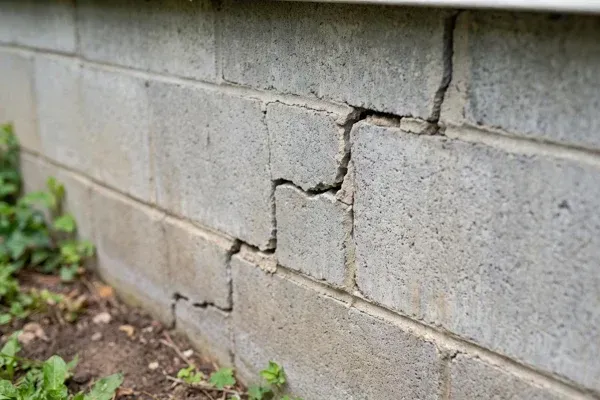
Direction tells the story. Vertical hairline cracks, especially in newer concrete, are usually cosmetic settling. Horizontal cracks and stair-step cracks that follow the mortar joints in a block or brick wall are the ones that signal structural stress. Expansive soils drive a large share of these. Along with frost heave and compressive soils, they cause more damage to structures in the U.S. than any other natural hazard, with losses estimated at seven billion dollars a year (Virginia Energy, 2024).
A horizontal crack across a basement wall is the one I never want a homeowner to ignore. It often means soil pressure is pushing the wall inward, and that pressure doesn’t relieve itself. Stair-step cracks suggest one part of the foundation is settling faster than another. Width is a clue too: a crack you can slide a nickel into deserves professional eyes. But width alone isn’t the whole picture, which is exactly why a trained diagnosis beats a guess.
| Warning sign | What it may mean | Urgency |
|---|---|---|
| Fine vertical hairline crack | Normal concrete curing or minor settling | Low, monitor it |
| Stair-step crack in brick or block | Differential settlement, one side sinking | Medium to high |
| Horizontal crack in basement wall | Soil or hydrostatic pressure pushing the wall in | High, call an engineer |
| Doors and windows sticking | Frame racking as the foundation shifts | Medium |
| Sloping or bouncy floors | Settlement or failing floor supports | Medium to high |
| Gaps at trim, crown molding, or baseboards | Walls or floors separating as things move | Medium |
| Bowing or leaning basement wall | Active structural failure under load | High, call an engineer now |
| Water intrusion or efflorescence | Drainage failure that accelerates movement | Medium, address the source |
Why do my doors and windows suddenly stick?
When a foundation shifts, the framing it supports racks slightly out of square, and door and window openings stop being perfect rectangles. That’s why a door that closed fine for years suddenly drags or won’t latch. It’s one of the most common early symptoms, and with the ASCE estimating that about one in four U.S. homes has been damaged by expansive soils (Virginia Energy, 2024), it’s worth noticing.
One sticking door during a humid August week is probably just wood swelling. But if several doors and windows across the house start sticking around the same time, or if you see cracks appearing above their corners, the frame itself is likely moving. That’s a structural signal, not a humidity one. Track whether it comes and goes with the seasons or gets steadily worse.
What do sloping or bouncy floors mean?
Sloping floors usually mean one section of the foundation has settled lower than the rest. Bouncy or spongy floors more often point to problems in the floor support system below, like undersized joists, failing girders, or a settling support pier. Either way, it’s movement, and movement is what turns a manageable repair into a major one over time. Foundation repair already averages about $5,176 nationally (HomeAdvisor, 2025), and letting differential settlement run pushes you toward the high end.
Have you ever set a marble on the floor and watched it roll to one wall? That old test still works. A slope of more than an inch or two across a room is a meaningful amount of differential movement. Bounciness near the center of a room, where spans are longest, suggests the beams and posts in your crawlspace or basement deserve a look. Both symptoms warrant a professional, because the fix depends entirely on the cause.
What causes bowing basement walls?
Bowing basement walls are caused by lateral pressure from the soil outside. When expansive clay absorbs water and swells, or when freeze-thaw cycles expand the ground, that pressure pushes horizontally against the wall. Over time the wall bows inward. Expansive soils like these damage more U.S. structures than any other natural hazard (Virginia Energy, 2024), and a bowing wall is among the most serious signs of it. It rarely resolves on its own.
The DMV’s clay-heavy soil and freezing winters make this a regional reality, not a rare event. A wall that bows more than an inch, or shows a horizontal crack along the middle, is under active structural stress. Left alone, a bowing wall can eventually fail. This is the symptom where I’d tell a family member to stop reading and pick up the phone. An engineer can measure the deflection and tell you whether it needs monitoring, carbon-fiber reinforcement, or wall anchors.
Should I worry about water in my basement or gaps at the trim?
Water intrusion and trim gaps are both worth attention, though for different reasons. Water itself may not be structural, but most foundation movement is driven by soil moisture, so a wet basement is often the cause behind other symptoms. The swelling and shrinking of water-laden expansive soils damages more U.S. structures than any other natural hazard (Virginia Energy, 2024). Gaps at trim signal that walls and floors are separating as the structure moves.
Efflorescence, that white chalky residue on basement walls, tells you water is passing through the concrete. That moisture feeds the swell-shrink cycle in the surrounding clay and speeds up movement. Gaps opening between your crown molding and ceiling, or baseboards pulling away from the floor, mean the surfaces they connect are drifting apart. Fixing the crack without fixing the water is like mopping the floor while the faucet runs.
Why should an engineer, not a contractor, diagnose the problem?
Because their incentives are different. A structural or geotechnical engineer is paid to diagnose the root cause and give you an unbiased assessment. A repair contractor makes money by selling a repair, so their “free inspection” often ends with a recommendation to buy their product. With foundation repair averaging about $5,176 nationally and running into five figures for major work (HomeAdvisor, 2025), an anxious homeowner is easy to upsell.
This is the reframe that saves DMV homeowners the most money. An engineer looks at the whole system: the soil, the drainage, the load paths, the pattern of cracks. They might tell you the movement is old and stable and needs nothing but monitoring. A contractor rarely reaches that conclusion because it doesn’t sell piers. Getting an independent diagnosis first means that if you do need repairs, you can hand contractors a scope of work and get honest, comparable bids instead of a sales pitch. If you want to understand what a structural engineer actually does, that independence is the whole point.
When should I call a structural engineer?
Call an engineer when you see horizontal or stair-step cracks, a bowing wall, floors that slope more than an inch across a room, or multiple symptoms appearing together. Call sooner rather than later: catching movement early is far cheaper than repairing a failed wall. With the ASCE estimating that about one in four U.S. homes has suffered expansive-soil damage (Virginia Energy, 2024), and repairs that climb into five figures, early diagnosis is your best defense.
You don’t need to wait for a crisis. If you’re buying a home, an engineer’s assessment is worth every dollar before you sign, which is why a dedicated structural inspection before buying a house is money well spent. If you already own and something feels off, a single assessment gives you clarity. Curious what that costs? Our guide to structural engineer fees breaks it down, and it’s a fraction of what unnecessary repairs would run.
Frequently Asked Questions
How much does foundation repair cost in the DMV?
Foundation repair averages about $5,176 nationally, with most homeowners spending between $2,225 and $8,135 (HomeAdvisor, 2025). Minor crack sealing can run a few hundred dollars, while major pier or wall work climbs into five figures. Our foundation repair cost guide covers DMV-specific factors in detail.
Are all foundation cracks a sign of a serious problem?
No. Most cracks are cosmetic. Fine vertical hairline cracks in concrete are common as it cures and settles. The ASCE estimates that about one in four U.S. homes has some damage from expansive soils (Virginia Energy, 2024), yet only a fraction of that is truly structural. The direction, width, and pattern of a crack tell you far more than its mere presence.
Does homeowners insurance cover foundation problems?
Usually not when the cause is gradual settling or expansive soil, which insurers treat as maintenance. Standard homeowner’s policies do not cover damage from expansive or compressive soils or frost heave (Virginia Energy, 2024), and because so much foundation movement traces to soil moisture, many claims get denied. Sudden covered events are different. Our guide on whether home insurance covers foundation repair explains the exclusions.
Why are foundation problems so common in the DMV?
The region sits largely on expansive clay soil that swells and shrinks with moisture, and freeze-thaw winters add pressure. Expansive soils cause a greater yearly financial loss to property owners than earthquakes, floods, hurricanes, and tornadoes combined (Geology.com, 2024), with U.S. losses from expansive and compressive soils and frost heave estimated at seven billion dollars a year (Virginia Energy, 2024). Older DMV homes with dated drainage feel it first.
How quickly do foundation problems get worse?
It varies. Some movement stabilizes and stays put for decades; other cases accelerate with each wet-dry or freeze-thaw cycle. Because the ASCE estimates about one in four U.S. homes has suffered expansive-soil damage (Virginia Energy, 2024), monitoring matters. An engineer can tell you whether yours is active or dormant, which decides how fast you need to act.
Koray Bozkurt, PE, PMP, is the founder and principal engineer of BOZ Engineering Group, a full-service firm licensed in DC, Maryland, Virginia, and Florida. He holds a master’s degree in geotechnical engineering and brings more than 18 years of structural design experience to residential and commercial projects across the DMV.