Erosion and Sediment Control Plan: A DMV Guide
By Koray Bozkurt, PE, PMP - Founder & Principal Engineer, BOZ Engineering Group. Last updated August 2026.
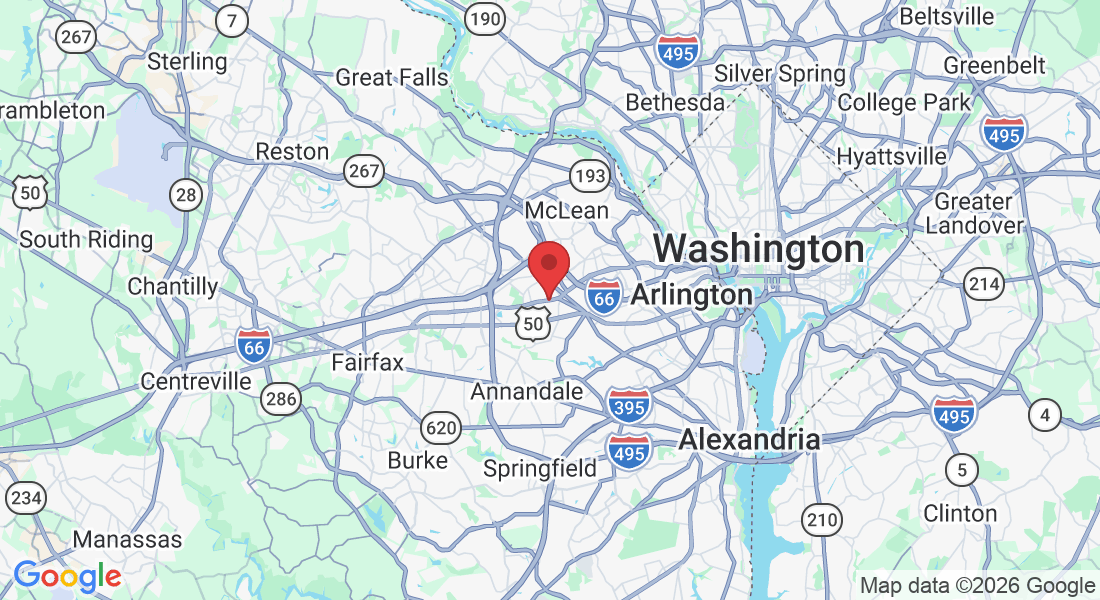
Break ground on almost any project in the DMV and you’ll hit the same question before a single excavator moves: where does the dirt go when it rains? An erosion and sediment control plan is the document that answers it. In Washington DC, an ESC plan is required once a project disturbs more than 50 square feet of land (DC DOEE), one of the lowest thresholds in the country. Cross into Virginia and the trigger jumps to 10,000 square feet. That gap trips up a lot of owners and contractors.
This guide explains what an erosion and sediment control plan is, why the DMV requires one, the exact land-disturbance thresholds that trigger it in DC, Maryland, and Virginia, what a compliant plan has to contain, and who is allowed to prepare and seal it. Get the threshold wrong and your permit stalls before it starts.
Key Takeaways
- An ESC plan (also called an E&S plan) keeps soil on your site during construction. DC requires one at just 50 square feet of disturbance (DC DOEE); Maryland at 5,000 square feet or 100 cubic yards (Maryland OneStop); Virginia at 10,000 square feet, or 2,500 in Chesapeake Bay Preservation Areas (Virginia Law).
- Disturb one acre or more anywhere in the DMV and a federal NPDES construction permit stacks on top of the local plan (US EPA).
- A compliant plan shows the limits of disturbance, perimeter controls like silt fence, sediment traps or basins, a stabilization strategy, and a written sequence of construction.
What is an erosion and sediment control plan?
An erosion and sediment control plan is an engineered drawing set and narrative that shows how a construction site will keep disturbed soil from washing off the property during grading and building. It maps the limits of disturbance, the perimeter controls, the sediment-trapping practices, and the order those go in and come out. It is your site’s rulebook for managing mud.
The plan goes by a few names. You’ll see “ESC plan,” “E&S plan,” and “soil erosion and sediment control (SESC) plan” used interchangeably across the DMV. They all describe the same thing: a temporary system of controls that protects streams, storm drains, and neighboring lots from the sediment that bare earth releases every time it rains. Sediment is the single largest pollutant by volume in construction runoff, which is exactly why regulators care.
An ESC plan is not the same as a stormwater management plan, though the two travel together. ESC controls the temporary erosion during construction. Stormwater management handles the permanent runoff after the project is finished. Most DMV projects of any size need both, and they’re often reviewed as one civil package alongside your site plan for the building permit.
Why does the DMV require an ESC plan?
The DMV requires ESC plans because bare, graded soil erodes fast, and the sediment it sheds clogs storm drains, chokes streams, and ultimately damages the Chesapeake Bay. Every jurisdiction here writes erosion control into local law under authority that traces back to the federal Clean Water Act, so the plan is a legal precondition to grading, not a suggestion.
Here’s the chain. The Clean Water Act regulates pollutant discharges into waters of the United States. Sediment counts as a pollutant. States and the District then run their own erosion programs to satisfy that mandate, and they attach the ESC plan to your grading or building permit as the enforcement hook. No approved plan, no permit. It’s that direct.
“Owners tend to think of erosion control as paperwork. It isn’t. It’s the one part of the permit set that protects your neighbor’s basement and the storm drain at the corner. Skip it or fake it, and the stop-work order writes itself.” - Koray Bozkurt, PE
The Bay is the reason the rules bite harder here than in much of the country. Virginia, Maryland, and DC all drain toward it, so all three treat sediment as a priority pollutant. That’s why Virginia drops its trigger from 10,000 square feet to just 2,500 inside Chesapeake Bay Preservation Areas (Virginia Law). Land near sensitive water gets watched more closely.
What land-disturbance thresholds trigger an ESC plan in DC, MD, and VA?
The threshold is the amount of land disturbance that legally forces you to file a plan, and it varies sharply across the three jurisdictions. DC triggers at 50 square feet, Maryland at 5,000 square feet or 100 cubic yards, and Virginia at 10,000 square feet (2,500 in Bay Preservation Areas). Above one acre, a federal permit applies everywhere.
“Land disturbance” means any grading, clearing, excavation, or filling that exposes soil. A modest addition, a new driveway, or a pool can cross a local threshold faster than owners expect, especially in the District. Here’s how the numbers line up.
| Jurisdiction | ESC plan trigger | Source |
|---|---|---|
| Washington DC | Disturbing or moving more than 50 sq ft of land | DC DOEE |
| Maryland | 5,000 sq ft or more, or 100 cubic yards or more | Maryland OneStop |
| Virginia (general) | 10,000 sq ft or more of land disturbance | Virginia Law |
| Virginia (Chesapeake Bay Preservation Area) | 2,500 sq ft or more | Virginia Law |
| Anywhere in the DMV (federal) | 1 acre or more (or part of a common plan reaching 1 acre) | US EPA |
Two cautions. First, localities can lower these numbers; Virginia’s regulation expressly lets a locality reduce the 10,000 square foot threshold (Virginia Law). Fairfax, Arlington, and your specific county may be stricter than the state floor. Second, small residential lots aren’t automatically safe. Where individual lots sit inside a larger development, Virginia counts the whole development’s disturbance, not just your slice. Confirm your local trigger before you assume you’re exempt, or check our overview of the land disturbance permit in the DMV.
When does a federal NPDES permit stack on the local plan?
Once a project disturbs one acre or more of land, a federal NPDES construction stormwater permit applies on top of the local ESC plan (US EPA). Smaller sites are pulled in too if they’re part of a larger common plan of development or sale that will ultimately disturb an acre or more.
That federal layer requires a Stormwater Pollution Prevention Plan (SWPPP), which folds your erosion and sediment controls into a broader pollution-prevention document. The federal Construction and Development rule sets baseline expectations: design and maintain effective erosion and sediment controls, and stabilize disturbed areas when work stops for more than 14 days (US EPA).
For a DMV homeowner doing an addition, one acre is a lot of dirt, so the federal permit rarely applies. For a developer clearing a subdivision or a commercial pad, it almost always does. The practical takeaway: an acre is the line where your project stops being a local matter and becomes a state-plus-federal one. Our civil engineering and site plan team handles both tiers on the same drawing set.
What does a compliant ESC plan contain?
A compliant ESC plan contains the limits of disturbance, perimeter sediment controls, sediment-trapping practices sized to the drainage area, a stabilization plan, and a written construction sequence. Virginia’s regulation requires the plan to include appropriate maps, a soil and water inventory, and a record of the conservation decisions behind the design (Virginia Law).
Strip away the jargon and a good plan answers five questions in order.
- Limits of disturbance. A clearly drawn boundary showing exactly how much ground gets opened. Everything outside it stays untouched, which is the cheapest erosion control there is.
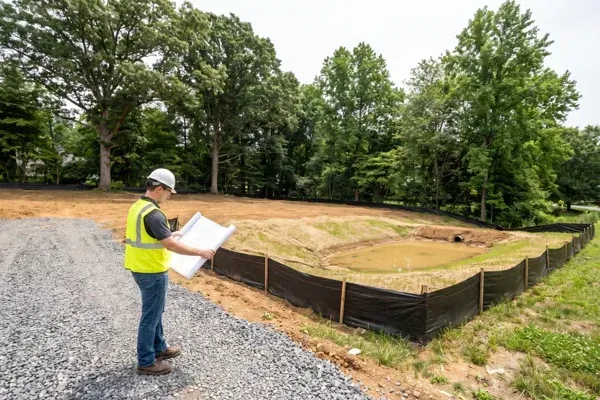
- Perimeter controls. Silt fence, super silt fence, or diversions ringing the downhill edges to catch sheet flow before it leaves the site.
- Sediment traps and basins. Where runoff concentrates, it gets routed to a trap or a sediment basin sized to hold the muddy water long enough for soil to settle out. Bigger drainage areas need basins; smaller ones use traps.
- Stabilization. Temporary seeding, permanent seeding, matting, or stone that covers bare soil so it stops eroding. Maryland’s 2011 standards tightened stabilization rules specifically to establish cover faster on idle ground (MDE).
- Sequence of construction. A step-by-step order that installs perimeter controls first, keeps them working through grading, and removes them only after the site is stabilized.
Maryland also caps most sites at a maximum 20-acre grading unit, meaning large jobs get phased so the whole parcel isn’t stripped at once (MDE). Phasing is one of the most effective controls on the plan, and it costs nothing but scheduling discipline. If your project also needs a grading plan or a retaining wall permit, those coordinate directly with the ESC sequence.
Who has to prepare and seal the ESC plan?
In the DMV, an erosion and sediment control plan tied to a site plan is generally prepared and sealed by a licensed professional engineer, because the sediment-basin sizing, drainage-area calculations, and grading design are engineering work. Virginia additionally requires a Responsible Land Disturber to be named and in charge of carrying out the approved plan on site (Virginia Law).
The reviewing authority differs by jurisdiction. DC’s Department of Energy and Environment (DOEE) reviews and approves ESC plans in the District. Maryland plans run through the local soil conservation district and the Maryland Department of the Environment. Virginia works through the local program under the state’s Virginia Erosion and Stormwater Management Program. Whoever reviews it, the plan has to be internally consistent, code-compliant, and buildable, which is where an experienced engineer earns the fee.
At BOZ Engineering Group, Koray Bozkurt is a licensed Professional Engineer in DC, Maryland, Virginia, and Florida, and he personally oversees the civil engineering on every plan set we seal. If DOEE returns ESC plan review comments, you talk to the engineer who drew the plan, not a call center. That direct line is what keeps a resubmission from turning into a month of delay.
Frequently Asked Questions
Do I need an ESC plan for a home addition in the DMV?
It depends on where you build and how much soil you disturb. In DC, disturbing more than 50 square feet triggers a plan (DC DOEE), so most additions qualify. In Virginia the general trigger is 10,000 square feet (Virginia Law), though localities can set it lower. Confirm your county’s threshold before you dig.
What’s the difference between an ESC plan and a stormwater management plan?
An ESC plan controls temporary erosion during construction; a stormwater management plan handles permanent runoff after the project is complete. Most DMV projects need both, reviewed together in one civil package. See our detailed breakdown of the stormwater management plan in the DMV for how the permanent side works and where the two overlap.
How big does a project have to be before a federal permit applies?
One acre. Disturbing one acre or more of land, or a smaller site that’s part of a common plan of development reaching one acre, requires a federal NPDES construction stormwater permit and a SWPPP (US EPA). That federal layer sits on top of, not instead of, your local ESC plan.
What is the limit of disturbance on an ESC plan?
The limit of disturbance (LOD) is the drawn boundary marking the maximum area that construction is allowed to clear or grade. Anything outside it stays undisturbed. A tight LOD is the simplest, cheapest erosion control on the plan, because undisturbed ground with intact vegetation doesn’t erode the way bare soil does.
Who approves ESC plans in Washington DC?
DC’s Department of Energy and Environment (DOEE) reviews and approves soil erosion and sediment control plans in the District (DC DOEE). Larger projects go through a full plan review; small disturbances under 5,000 square feet with no stormwater management can qualify for a streamlined minor review process.
Ready to get your ESC plan approved?
If you’re planning a project anywhere in the DMV, the erosion and sediment control plan is one of the first approvals that stands between you and a permit. BOZ Engineering Group has prepared civil and site plans across DC, Maryland, and Virginia since 2008, and a licensed PE oversees every drawing we seal. We size the basins, draw the limits of disturbance, write the construction sequence, and stay with the project through agency review.
Want the permit path handled end to end? Our permit expediting service manages submissions and review comments so you’re not chasing jurisdictions. Start with a conversation. Contact us and you’ll talk directly to the engineer who does the work.
The bottom line
An erosion and sediment control plan is not optional in the DMV, and the threshold that triggers it is far lower than most owners expect, especially DC’s 50 square foot line. Know your jurisdiction’s number, know whether the one-acre federal permit stacks on top, and build the plan around a tight limit of disturbance, real perimeter controls, and an honest construction sequence.
The single most important next step is confirming your local threshold before you file for a grading or building permit, because the plan has to be approved first. If you’re weighing a project and aren’t sure what applies, our civil engineering and site plan team will map the requirements to your specific lot and get you to an approvable plan.
Koray Bozkurt, PE, PMP is the founder and principal engineer of BOZ Engineering Group, a structural, civil, geotechnical, and MEP engineering firm serving Washington DC, Maryland, Virginia, and Florida since 2008. A licensed Professional Engineer in DC, Maryland, Virginia, and Florida, he is WACEL certified in soil, concrete, foundation inspection, and structural masonry, and personally oversees the engineering on every BOZ project. Learn more about Koray.