Perc Test Cost in the DMV (2026 Guide)
By Koray Bozkurt, PE, PMP - Founder & Principal Engineer, BOZ Engineering Group. Last updated August 2026.
Before an unsewered lot in the DMV can hold a house, one field test often decides whether you can build at all: the perc test. Perc test cost is modest next to what it protects, usually landing somewhere from a few hundred to a few thousand dollars depending on the county, the number of holes, and how the ground behaves. If the soil can’t absorb wastewater at an acceptable rate, no septic system gets permitted, and a lot you thought was buildable suddenly isn’t.
A percolation test, or perc test, measures how fast water drains through the soil where a septic drainfield would go. This guide covers what a perc test is, what drives the cost, how the DMV process works and who witnesses it, what a failed perc means for your project, and how a septic soil test connects to a full geotechnical soils investigation.
Key Takeaways
- A perc (percolation) test measures how fast water moves through soil. In-ground gravity septic systems generally need percolation rates between 6 and 60 minutes per inch on slopes under 25 percent (Penn State Extension, 2026).
- In Montgomery County, MD, a lot that can’t connect to public sewer “must complete satisfactory water table tests and percolation or sand mound testing… before it can be considered buildable” (Montgomery County DPS, 2026).
- Perc test cost is driven mostly by the number of test holes, soil and groundwater conditions, and county health-department fees. Because published local figures are scarce, treat costs as ranges and confirm a current number with your county.
- A failed perc doesn’t always kill a lot. Slower or faster soils often still support an alternative system like an elevated sand mound, at higher cost.
What is a perc test?
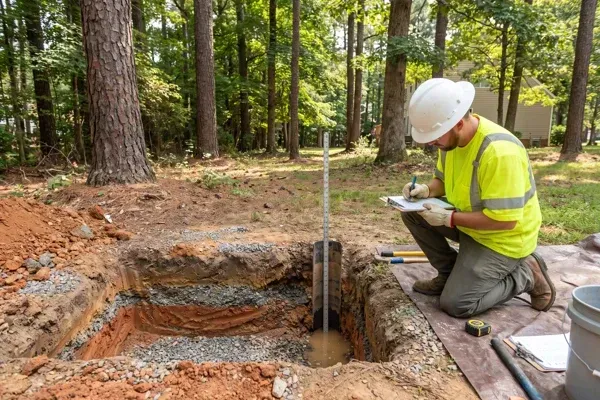
A perc test is a field measurement of how quickly water drains through the soil where a septic drainfield would sit. A hole is dug to the depth of the proposed absorption field, saturated with clean water, and then timed as the water level drops. That drop rate, expressed in minutes per inch, tells engineers and health officials whether the ground can accept and treat wastewater.
The test matters because a septic system relies entirely on soil to do its job. As the EPA puts it, “The soil accepts, treats, and disperses wastewater as it percolates through the soil, ultimately discharging to groundwater,” and the drainfield itself is “a shallow, covered, excavation made in unsaturated soil” (US EPA, 2026). If that soil drains too slowly or too fast, the system fails. A perc test is how you find out before you build, not after.
Why is a perc test required before a septic system?
Because soil is the treatment system, and not all soil works. Wastewater “percolates into the soil, naturally removing harmful coliform bacteria, viruses and nutrients” (US EPA, 2026). If effluent moves too fast, it reaches groundwater before it’s treated. Too slow, and the drainfield floods and surfaces. The perc test confirms the soil sits in the workable range.
That’s why DMV jurisdictions won’t permit a septic system on faith. In Virginia, “VDH requires a sewage disposal construction and/or well construction permit for installation, modification, or repair of a septic tank, dispersal field or well” (Virginia Department of Health, 2026). No verified soil, no permit. The septic soil test is the gate every unsewered lot has to pass, and it’s the same principle behind a broader geotechnical soils investigation: you verify the ground before you commit a design to it.
How much does a perc test cost in the DMV?
Perc test cost in the DMV typically runs from a few hundred dollars for a simple county-run test on an easy site to a few thousand for a lot that needs multiple deep holes, private soil-consultant fees, and repeat visits. Reliable published local figures are scarce, so any single number you see online should be confirmed with your county health department or permitting office before you budget around it.
Costs vary because a perc test isn’t one flat service. In some counties the health department performs the testing for a set fee while you pay separately for an excavator to dig the holes. In others, you hire a private soil evaluator who charges by the site. The table below breaks down what moves the price. For where a septic soil test fits against the rest of your site-work budget, our guide to geotechnical report cost puts the pieces side by side.
| Cost factor | Why it moves the price | Typical direction |
|---|---|---|
| Number of test holes | Each hole adds excavation, saturation, and timing | More holes, higher cost |
| Depth of holes | Deep-hole and water-table evaluations take longer and need bigger equipment | Deeper, higher cost |
| Soil and groundwater conditions | Slow clay, rock, or a high water table can force retests or a sand-mound design | Difficult ground, higher cost |
| County health-department fees | Each jurisdiction sets its own testing and permit fee schedule | Varies by county |
| Excavator / site prep | You often pay a separate excavator to stake and dig test sites | Adds a line item |
| Private soil consultant | Hiring a C/AOSE or evaluator adds a professional fee | Higher on complex lots |
| Retesting | A failed or inconclusive test may need to be repeated in the wet season | Delays and added cost |
The ranges here are planning guidance, not a quote, so confirm the current figure with your county health department or a soil evaluator before you budget. A flat, well-drained lot with one round of testing sits at the low end. A wooded, sloped, or clay-heavy site that needs multiple deep holes and a repeat visit sits well above it.
Who witnesses a perc test, and how does the DMV process work?
The local health department or permitting authority controls the process, and in most DMV jurisdictions an official either performs or witnesses the test. It isn’t something a property owner runs alone and self-certifies. The county sets the test locations, oversees the timing, and signs off on the result that goes into the permit file.
Montgomery County, Maryland is a clear example. There, “the Department of Permitting Services (DPS), acting on behalf of the Maryland Department of the Environment (MDE), has the responsibility of testing for and permitting wells and septic systems” (Montgomery County DEP, 2026). Testing happens in two stages: first a water table test to find the depth to groundwater, then the percolation test itself. County inspectors conduct the testing after the applicant stakes the approved locations and hires an excavator to prepare them.
Timing matters more than people expect. In Montgomery County, “water table tests may only be conducted in a declared wet season, typically February 1st thru April 15th” (Montgomery County DPS, 2026). Miss the window and you can lose a year. In Virginia, VDH runs the onsite program and “recommend[s] hiring a private soil consultant (C/AOSE)” to locate a drainfield (Virginia Department of Health, 2026). Either way, the health department decides whether your soil passes.
“People treat a perc test like a formality, then lose a whole building season because they missed the wet-season window or dug the holes in the wrong spot. Get the soil evaluated early, on the health department’s calendar, not yours.” - Koray Bozkurt, PE
What percolation rate passes, and what fails?
Passing comes down to a number: how many minutes it takes water to drop one inch in the test hole. In-ground gravity drainfields “can be placed on soils with percolation rates between 6 - 60 minutes per inch and land slopes that do not exceed 25%” (Penn State Extension, 2026). Land outside that band, and a standard system usually won’t work as-is.
The two failure modes sit at opposite ends. If water drains faster than about 6 minutes per inch, effluent races through before the soil can treat it, risking groundwater contamination. If it’s slower than roughly 60 minutes per inch, the soil can’t accept flow fast enough and the drainfield backs up or surfaces. Sites with “slower or faster percolation rates will require more complex distribution systems such as elevated sand mounds” (Penn State Extension, 2026). Clay-heavy DMV soils tend to fail slow, which is exactly why local testing is non-negotiable.
What does a failed perc test mean for your lot?
A failed perc doesn’t automatically mean you can’t build, but it does mean a standard, cheap gravity septic system is off the table. Slow or fast soil usually still supports an engineered alternative, most often an elevated sand mound or another advanced system, at meaningfully higher design and construction cost. The catch is that those systems need more land and more engineering.
Space is the other constraint people miss. In Montgomery County, “a septic system for a new building lot must have an initial drainfield and enough area for up to three reserve or back-up drainfields” (Montgomery County DEP, 2026). A lot that percs but can’t fit the reserve area still won’t get a permit. If your septic soil test comes back marginal, the next move is a licensed engineer who can weigh an alternative system against the site’s real soil and slope, the same judgment behind a grading plan and the land disturbance permit that often follow.
How does a perc test tie into a geotechnical soils investigation?
A perc test answers one question, whether soil can absorb wastewater, while a geotechnical soils investigation answers a broader one, whether the ground can carry a structure. They’re separate tests, but they overlap on the same lot and often get scheduled together. Both start by putting holes in the ground and reading what comes out.
Where a perc test times water in a shallow drainfield hole, a geotechnical investigation drills deeper borings, samples the soil, measures groundwater, and estimates load-bearing capacity for foundations. On a raw lot you may need both: the perc test for the septic permit and the geotechnical work for the foundation. The soil that percs poorly is often the same expansive clay that worries a foundation, which is why soil bearing capacity and drainage surface together. When one team handles both, the recommendations connect straight to a stamped foundation design and the civil and site-plan work that ties grading, drainage, and the drainfield into one approvable package. Poor drainage in a perc test can also foreshadow the water problems behind many signs of foundation trouble later.
Frequently Asked Questions
How much does a perc test cost in the DMV?
Perc test cost in the DMV generally ranges from a few hundred dollars for a simple county-run test to a few thousand for a lot needing multiple deep holes, a private soil consultant, or repeat visits. Verified local figures are scarce, so confirm the current fee with your county health department or permitting office before budgeting.
Who performs and witnesses a perc test?
Your local health department or permitting authority. In Montgomery County, DPS, “acting on behalf of the Maryland Department of the Environment (MDE), has the responsibility of testing for and permitting wells and septic systems” (Montgomery County DEP, 2026). In Virginia, VDH runs the onsite program and issues the permit.
What percolation rate passes a perc test?
For a standard in-ground gravity drainfield, soils generally need percolation rates “between 6 - 60 minutes per inch” on slopes under 25 percent (Penn State Extension, 2026). Faster soil risks untreated effluent reaching groundwater; slower soil can’t accept flow and may require an engineered alternative system.
When can a perc test be done?
Often only in a wet season. Montgomery County allows water table tests “only… in a declared wet season, typically February 1st thru April 15th” (Montgomery County DPS, 2026). Because seasonal groundwater affects results, timing your test correctly can prevent losing an entire building season.
What happens if my lot fails the perc test?
A failed perc rules out a basic gravity septic system, but the lot often still supports an engineered alternative like an elevated sand mound at higher cost (Penn State Extension, 2026). You’ll also need room for the drainfield plus reserve area, so a licensed engineer should evaluate the options.
Ready to get your soil evaluated the right way?
If you’re buying or building on an unsewered lot in the DMV, the perc test and the soil under your foundation both decide what you can build, and both are easier to solve before the design is locked. BOZ has served DC, Maryland, and Virginia since 2008, we’re licensed Professional Engineers in DC, Maryland, Virginia, and Florida, and you talk to the engineer who does the work. Schedule a consultation and we’ll help scope the testing your site needs.
The bottom line
Perc test cost is mostly a function of how many holes you need, how deep they go, and what your county charges, which is why a simple site lands in the low hundreds and a difficult one climbs into the thousands. The test is cheap insurance against buying or building on a lot that can’t legally hold a septic system.
The smart move is to test early, on the health department’s wet-season calendar, and to pair the septic soil test with real geotechnical work when you’re building new. Talk to our geotechnical engineering team or learn more about BOZ, and you’ll get a straight answer on what your lot requires and how the permitting fits together.
Koray Bozkurt, PE, PMP is the founder and principal engineer of BOZ Engineering Group, a structural, civil, geotechnical, and MEP engineering firm serving Washington DC, Maryland, Virginia, and Florida since 2008. A licensed Professional Engineer in DC, Maryland, Virginia, and Florida, he is WACEL certified in soil, concrete, foundation inspection, and structural masonry, and personally oversees the engineering on every BOZ project. Learn more about Koray.