Soil Bearing Capacity: What It Means for Foundations
By Koray Bozkurt, PE, PMP - Founder & Principal Engineer, BOZ Engineering Group. Last updated August 2026.
Every foundation in the DMV rests on one number most homeowners never hear: soil bearing capacity, the load the ground can safely carry before it settles or fails. Get it right and your footings are sized correctly. Get it wrong and you invite cracks, tilting, and expensive repairs. That risk isn’t rare, either. Expansive soils that swell and shrink with moisture affect “one in five” people nationally, compared with “one in ten” for floods (Colorado Geological Survey, 2026), and the clay-rich ground across Northern Virginia and Maryland behaves the same way.
This guide explains what soil bearing capacity actually means, the difference between allowable and ultimate values, and why that number decides your footing size and foundation type. You’ll see the presumptive load-bearing values the building code lets engineers use without testing, when a geotechnical investigation is required instead, and how local soils shape the whole calculation.
Key Takeaways
- Soil bearing capacity is the pressure the ground can support. Engineers design to the allowable bearing pressure, which builds a safety margin into the ultimate capacity at which soil would fail.
- Without a soil investigation, the building code lets engineers use conservative presumptive load-bearing values, ranging from 1,500 psf for clay and silt up to 12,000 psf for crystalline bedrock (2021 IBC, Table 1806.2, 2021).
- A geotechnical investigation is required for specific conditions, including expansive soil, questionable soil, deep foundations, and groundwater within 5 feet of the lowest floor (2021 IBC, Section 1803.5, 2021).
- Expansive and shrink-swell soils cause “a few billion dollars worth of damages” a year, “more than twice the damage from floods, hurricanes, tornadoes, and earthquakes” (Colorado Geological Survey, 2026), and DMV clay puts many local sites in that conversation.
What is soil bearing capacity?
Soil bearing capacity is the maximum pressure the ground can support without failing or settling too much. It’s usually expressed in pounds per square foot (psf). Engineers work with two versions: ultimate bearing capacity, the pressure at which the soil actually gives way, and allowable bearing pressure, the safe working value after dividing by a factor of safety. Foundations are designed to the allowable number, not the ultimate one.
That factor of safety matters. Ultimate capacity is the failure point, so designing right up to it would leave no margin for variation in the soil, the loads, or the workmanship. By using a fraction of that limit, an engineer builds in room for the unknowns that every real site carries. When you read a soils report and see a “design bearing value,” you’re looking at that allowable pressure, the number the footings are actually sized against.
Why does bearing capacity govern footing size and foundation type?
Bearing capacity sets footing size directly: the weaker the soil, the wider the footing has to be to spread the same load. A column pushing 30,000 pounds onto soil rated at 2,000 psf needs about 15 square feet of footing. On 1,500 psf clay, that same column needs more. Halve the soil’s strength and you roughly double the footing area.
Here’s a fair question: why not just build a bigger footing everywhere and stop worrying? Because at some point spreading the load stops being practical or affordable, and the answer becomes a different foundation type. Weak or deep soft soils push a project toward reinforced mats, deeper footings, or piles that reach down to firmer material. A structural engineer reads the bearing value first, then chooses the system that fits it. If your soil is strong, shallow spread footings usually do the job and the foundation design stays simple.
What are the code’s presumptive load-bearing values?
When no soil investigation is done, the building code lets an engineer assume conservative presumptive load-bearing values by soil class. Under the International Building Code, those allowable vertical foundation pressures run from 1,500 psf for clay and silt up to 12,000 psf for crystalline bedrock (2021 IBC, Table 1806.2, 2021). The residential code carries the same figures in Table R401.4.1 (2021 IRC, 2021).
| Soil or rock class (IBC Table 1806.2) | Allowable vertical foundation pressure |
|---|---|
| Crystalline bedrock | 12,000 psf |
| Sedimentary and foliated rock | 4,000 psf |
| Sandy gravel and/or gravel (GW and GP) | 3,000 psf |
| Sand, silty sand, clayey sand, silty gravel and clayey gravel (SW, SP, SM, SC, GM and GC) | 2,000 psf |
| Clay, sandy clay, silty clay, clayey silt, silt and sandy silt (CL, ML, MH and CH) | 1,500 psf |
Source: 2021 IBC, Table 1806.2, 2021.
Notice the spread. Bedrock carries eight times what clay does, which is exactly why the soil under your footings changes the whole design. These are deliberately conservative defaults. The code does allow the tabulated pressures “to be increased by one-third” when used with load combinations that include wind or earthquake (2021 IBC, Section 1806.1, 2021), but the base numbers stay cautious because they assume nothing has been measured.
When can engineers use presumptive values, and when is testing required?
Presumptive values are a fallback for straightforward sites with known, competent soil. They’re legal and common, but they’re conservative by design, so they can force larger footings than the ground actually needs. On many DMV lots they’re the sensible starting point. On others, the code takes the choice out of your hands and requires a geotechnical investigation instead.
The IBC requires that investigation for specific conditions, including questionable soil, expansive soil, deep foundations, a groundwater table within 5 feet of the lowest floor, varying rock strata, and shallow foundations bearing on more than 12 inches of compacted fill (2021 IBC, Section 1803.5, 2021). The residential code adds another trigger: where the building official believes soils below 1,500 psf are likely, “the allowable bearing capacity shall be determined by a soils investigation” (2021 IRC, Section R401.4.1, 2021).
“Presumptive values are a safe guess, not a measurement. On known soil they’re fine. But the moment you hit fill, expansive clay, or an addition loading old footings, testing stops being optional and starts being the cheapest insurance on the job.” - Koray Bozkurt, PE
In practice, new construction on an unknown lot, a second-story addition that adds load to existing footings, and any project on filled ground tend to land in that required-testing category. When you’re unsure, a quick call with a structural engineer settles it before design begins.
How do DMV clays, fill, and expansive soils affect bearing capacity?
They lower it and make it move. Clay-rich soils common across the DMV hold moisture, and moisture is what makes them swell and shrink through the seasons. That movement is behind a large share of foundation trouble: nationally, expansive soils cause “a few billion dollars worth of damages” a year, “more than twice the damage from floods, hurricanes, tornadoes, and earthquakes” (Colorado Geological Survey, 2026).
The code doesn’t leave “expansive” to opinion. Soil qualifies when it meets hard criteria, including a plasticity index of 15 or greater, more than 10 percent of particles passing a No. 200 sieve, and an expansion index greater than 20 (2021 IBC, Section 1803.5.3, 2021). You can’t eyeball those numbers from a shovelful of dirt. Add undocumented fill from lots graded decades ago, and the true bearing value under a footing is genuinely unknown until it’s measured.
This is why local ground drives so many testing decisions. When bearing capacity is low or seasonal, footings spread wider, foundations go deeper, and details change. If movement has already started, the symptoms show up as signs of foundation problems or a bowing basement wall, and the fix, from foundation repair to basement underpinning, traces straight back to what the soil could carry.
How does a soils report establish a design bearing value?
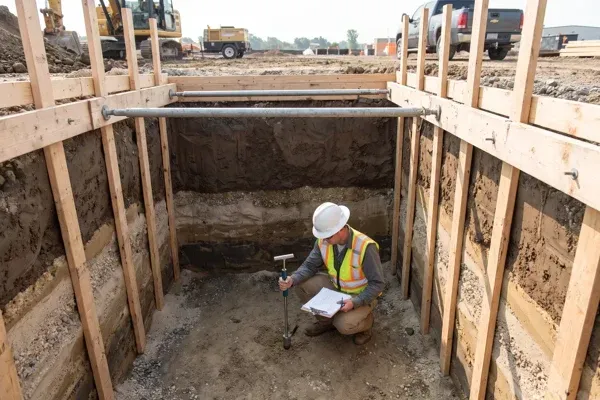
A geotechnical report turns guesswork into a measured number. Field crews drill soil borings, run penetration tests that index soil strength, log groundwater, and send samples to a lab. From that data a licensed engineer calculates the allowable bearing pressure for your specific site, then writes it into the report as the design bearing value the foundation is built to.
That value often beats the presumptive one, which lets the engineer use smaller, cheaper footings. Sometimes it comes in lower, and you’re glad to learn that on paper instead of in a cracked slab. Either way, the report also flags expansive soil, fill, and groundwater so the design handles them up front. Curious what that study runs? Our guide to geotechnical report cost breaks down the drivers, and a related perc test covers drainage on septic sites. At BOZ, our geotechnical engineering team produces the report, and because the same licensed PE also handles the foundation and retaining wall design, the bearing value flows straight into a code-compliant, PE-stamped plan.
Frequently Asked Questions
What is a good soil bearing capacity for a house?
It depends on the soil, but strong sands and gravels carry 2,000 to 3,000 psf and bedrock reaches 12,000 psf, while clay and silt sit at the code’s floor of 1,500 psf (2021 IBC, Table 1806.2, 2021). Higher values mean smaller footings and simpler foundations.
What’s the difference between allowable and ultimate bearing capacity?
Ultimate bearing capacity is the pressure at which soil actually fails. Allowable bearing pressure is the safe working value after applying a factor of safety, and it’s the number foundations are designed to. Presumptive code values, like the 1,500 to 12,000 psf range in the IBC, are allowable pressures (2021 IBC, Table 1806.2, 2021).
Do I always need a soil test to design a foundation?
No. The code lets engineers use presumptive load-bearing values on straightforward sites. But testing is required for conditions like expansive soil, questionable soil, deep foundations, and groundwater within 5 feet of the lowest floor (2021 IBC, Section 1803.5, 2021), which cover many DMV projects.
How does soil bearing capacity affect footing size?
Directly. Footing area equals the load divided by the allowable bearing pressure, so weaker soil needs a wider footing to spread the same weight. Cut the bearing value in half, from 3,000 psf gravel to 1,500 psf clay, and the required footing area roughly doubles for the same column load.
Why is DMV clay soil a problem for foundations?
Clay holds water, then swells and shrinks as moisture changes, which stresses footings and slabs. Expansive soils cause damage “more than twice” that of floods, hurricanes, tornadoes, and earthquakes nationally (Colorado Geological Survey, 2026). Local clay and old fill make measured bearing values important here.
Ready to find out what your soil can carry?
If you’re planning new construction, an addition, or a retaining wall in the DMV, the bearing value under your project decides the foundation, and guessing is the expensive option. BOZ has served DC, Maryland, and Virginia since 2008, our founding engineer works every project, and you talk to the licensed PE who does the work. Schedule a consultation or reach our geotechnical engineering team, and we’ll tell you whether your site needs a soils investigation.
The bottom line
Soil bearing capacity is the quiet number behind every footing decision. It sets how wide your footings are, which foundation type makes sense, and whether the code lets you lean on presumptive values or requires a real geotechnical investigation. In a region shaped by clay and old fill, that number is rarely something to assume.
The smart move is to ask early, before the design is locked, what your soil can actually support. Talk to our geotechnical engineering team or learn more about BOZ, and you’ll get a straight answer on the bearing value your project should be designed to.
Koray Bozkurt, PE, PMP is the founder and principal engineer of BOZ Engineering Group, a structural, civil, geotechnical, and MEP engineering firm serving Washington DC, Maryland, Virginia, and Florida since 2008. A licensed Professional Engineer in DC, Maryland, Virginia, and Florida, he is WACEL certified in soil, concrete, foundation inspection, and structural masonry, and personally oversees the engineering on every BOZ project. Learn more about Koray.