Backyard Drainage Solutions That Protect Your Foundation
By Koray Bozkurt, PE, PMP - Founder & Principal Engineer, BOZ Engineering Group. Last updated October 2026.
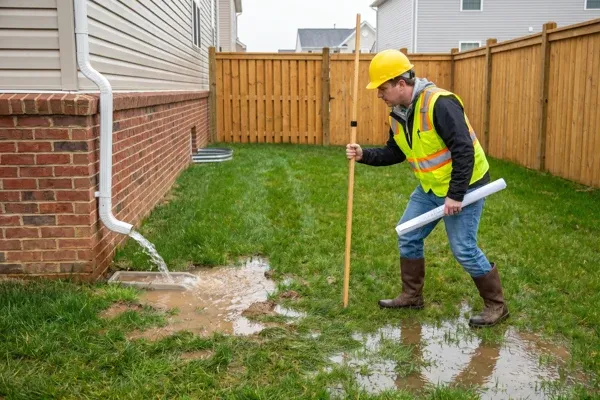
A backyard that stays soggy for days after every storm is telling you something about where your water goes. When a yard remains wet for 2 or 3 days after rain, the natural drainage paths may be blocked or may have settled and no longer have enough grade to drain (Northern Virginia Soil and Water Conservation District, 2022). Good backyard drainage solutions restore that path before the water reaches your foundation.
Here’s how an engineer diagnoses a wet lot, which fixes come first, and when you need an engineered plan and a permit in the DMV.
Key Takeaways
- The residential code requires at least 6 inches of fall within the first 10 feet of your foundation, or drains and swales where lot lines prevent it (International Code Council, 2021 Virginia Residential Code R401.3, 2021).
- Start with roof water: downspouts should end at least 5 feet from the foundation (U.S. DOE Building America Solution Center, 2021).
- In DMV marine clay, runoff may stand for long periods wherever the ground has less than a 2 percent slope (Fairfax County, 2013).
- Standing water beside the house is a foundation question, not just a lawn problem. Find the source, then design the fix.
Why is my backyard always wet?
A backyard stays wet when rain has nowhere to go: the ground is flat or slopes toward the house, downspouts dump roof water in the wrong spot, clay or compacted soil won’t absorb it, groundwater sits near the surface, or a neighbor’s runoff crosses your lot. Many wet yards have more than one at once.
Grade is the usual culprit. Soil around a foundation often settles over time, and water ponds in those settled areas (Northern Virginia Soil and Water Conservation District, 2022). A negative grade, tilting toward the house, makes it worse. A new patio or planting bed can undo the original grade.
Then add volume. Reagan National averages 41.82 inches of precipitation a year (NOAA NCEI 1991-2020 normals, 2021). In the marine clays found in parts of Virginia, DC, and Maryland, that water percolates so slowly it collects in flat yard areas, and sand layers can carry groundwater that surfaces as springs (Fairfax County, 2013).
| What you see | Likely cause | First check |
|---|---|---|
| Puddles along the foundation | Negative grade or settled backfill | Fall over the first 10 feet (minimum 6 inches) |
| Soggy patch at a downspout | Roof water released too close | Extend the outlet |
| Lawn wet 2 to 3 days after rain | Flat grade, compacted or clay soil | Percolation test |
| Wet ground in dry weather | High groundwater or a spring | Does a test hole fill from below? |
| Water arriving at the lot line | Neighbor runoff or a filled-in swale | Walk the lot line in a storm |
| Wet yard plus seepage or new cracks | Water reaching the foundation | Engineer’s assessment |
How do you find the source of standing water in your yard?
Watch the yard during a storm, then test the soil. Note where water enters the lot, where each downspout discharges, and how long puddles last. Check the grade near the house against the 6-inches-in-10-feet rule, and run a percolation test to see whether the soil absorbs water.
For the percolation test, dig a hole 12 inches deep and 12 inches across, fill it, and refill it the next day. All of the water should drain within 8 hours. Slower than 1 inch per hour can point to compaction, high clay content, buried debris, a high water table, or a restrictive layer (University of Maryland Extension, 2023).
What if every test points somewhere different? That’s normal. An engineer ties storm observations, soil behavior, and spot elevations into one picture before recommending anything.
When does standing water near the foundation become a structural problem?
It becomes structural when water keeps the soil against your foundation saturated. Wet backfill pushes harder on basement walls, water can build pressure under the slab, and swelling clays can move footings. If the wet yard comes with basement seepage, new cracks, or sticking doors, the drainage question has become a foundation question.
Grading away from the house exists to stop water standing against the wall, where it can seep through or cause water pressure under the basement floor (Northern Virginia Soil and Water Conservation District, 2022). In marine clay, swelling pressure can far exceed the strength of basement walls (Fairfax County, 2013). See bowing basement walls and the signs of foundation problems.
That’s why the yard comes first. No waterproofing system is 100% foolproof, so the best defense is keeping water from saturating the soil around the foundation (U.S. DOE Building America Solution Center, 2020). Already wet inside? Start with water in the basement.
“A lot of the foundation calls I get start as a drainage problem in the yard. Fix where the water goes before it reaches the wall, and you’re protecting the structure instead of chasing leaks from the inside.” - Koray Bozkurt, PE
What are the best backyard drainage solutions?
The best backyard drainage solutions run from simple to involved: fix gutters and extend downspouts, regrade so the ground falls away from the house, shape swales to carry water around it, then add subsurface drains or dry wells where soil or groundwater demands it. Match each fix to the cause you found.
Downspout drainage first. DOE guidance calls for outlets at least 5 feet from the foundation (U.S. DOE Building America Solution Center, 2021), and Fairfax County’s marine clay guide asks for 10 feet. Arlington adds: don’t aim concentrated flow at a neighbor’s property line, and don’t tie several downspouts together (Arlington County, 2026).
Regrade and add swales. Code sets the floor at 6 inches of fall in 10 feet, with drains or swales where lot lines block it. The conservation district suggests about 5 percent near the house and 2 percent elsewhere (Northern Virginia Soil and Water Conservation District, 2022).
Subsurface drains fit yards too flat or wet from below. The district’s example is a 2-foot-deep trench with perforated pipe in gravel, leading to a suitable outlet. A curtain drain runs that trench across the slope. For drains at the footing, see foundation drainage.
Dry wells suit roof water with no outlet: a small underground pit filled with stone that lets water soak into the soil (Montgomery County DEP, 2026). If a 12-inch test hole doesn’t drain within 48 hours, pick another spot or amend the soil and add an underdrain (Northern Virginia Soil and Water Conservation District, 2018).
| Fix | Solves | Watch out for |
|---|---|---|
| Downspout extensions | Roof water at the foundation | Outlet can’t dump on a neighbor |
| Regrading | Negative grade, settled backfill | Lot lines, patios, permit thresholds |
| Swale | Surface water crossing the lot | Needs fall and a legal outlet |
| French or curtain drain | Flat, saturated ground | Needs an outlet; can clog |
| Dry well | Roof water with no outlet | Needs soil that passes a 48-hour test |
Not sure which combination your lot needs? Our grading and drainage plans start with a site visit and end with PE-stamped drawings.
Do you need a permit to regrade your yard in the DMV?
Often not for small work, but it depends on where you live. Arlington says contouring less than 2,500 square feet usually doesn’t need a plan or building permit (Arlington County, 2026), while DC requires an erosion and sediment control plan once a project disturbs more than 50 square feet (DC DOEE, 2026).
Fairfax County regulates disturbance at 2,500 square feet and exempts some home landscaping, though applying those exemptions “generally requires additional guidance and interpretation from staff” (Fairfax County LDS, 2026). Montgomery County requires a sediment control permit for 5,000 square feet or more of disturbance, or 100 cubic yards or more of earth movement (Montgomery County DPS, 2026), and Prince George’s County requires a grading permit for grading more than 5,000 square feet or moving more than 100 cubic yards of soil (Prince George’s County, 2026). See when you need a grading plan and the land disturbance permit for details.
What if the water is coming from your neighbor’s yard?
Usually it’s a private matter between neighbors. Fairfax County calls drainage directed from a neighbor’s gutters or downspouts “a civil matter between the property owners” (Fairfax County, 2026), and Arlington says it has no authority to resolve private drainage disputes. Your practical tool is a plan that manages water on your own lot.
The rule cuts both ways: Arlington says owners shouldn’t build systems that leave standing water on a neighbor’s property. Montgomery County requires a drainage plan when a new house or an addition over 400 square feet of footprint, on a lot under 15,000 square feet, would drain onto adjacent private property and no stormwater management plan is already approved (Montgomery County DPS, 2026). For the dispute, see an attorney. For the water, a drawing with real elevations shows where it can go.
When does a wet yard need an engineered grading and drainage plan?
Bring in an engineer when water is reaching the foundation, simple fixes haven’t worked, the lot is flat or sits on clay with high groundwater, the work crosses a permit threshold, or your fix could send water toward a neighbor. The plan sets elevations, slopes, and outlets so the fix targets the cause.
Soil matters too. Fairfax County’s code requires a soils report by a qualified engineer for all new construction and grading work in marine clay (Fairfax County, 2013), which is where soil analysis and testing fits. Bigger projects may need a stormwater management plan. We’re the engineer, not the installer: we find the source, design the drainage solution, and if water has damaged the structure, design the foundation repair your contractor builds.
Frequently Asked Questions
How far should downspouts drain from the house?
At least 5 feet from the foundation, or into an underground catchment at least 10 feet away (U.S. DOE Building America Solution Center, 2021). In Fairfax County’s marine clay areas, the county’s guide asks for 10 feet. Never aim concentrated flow at a neighbor’s property line.
How much should my yard slope away from the house?
Code requires at least 6 inches of fall within the first 10 feet of the foundation. Virginia’s code requires hard surfaces within 10 feet to slope at least 1 percent away (International Code Council, 2021), where the model IRC calls for 2 percent (International Code Council, 2021). Beyond that zone, Northern Virginia’s conservation district suggests about 2 percent.
Is a French drain or a dry well better for a wet yard?
It depends on the soil and the outlet. A French drain carries water through gravel and perforated pipe to a safe discharge point. A dry well stores water until the soil absorbs it, so it needs a spot where a test hole drains within 48 hours (Northern Virginia Soil and Water Conservation District, 2018).
How long should water stand in a yard after rain?
Not long. If part of your yard stays soggy for 2 or 3 days after rain, the natural drainage paths may be blocked or may have settled (Northern Virginia Soil and Water Conservation District, 2022). A percolation test that drains slower than 1 inch per hour can point to compaction, clay, or high groundwater.
Can standing water in the yard damage my foundation?
It can, when it saturates the soil against the house. Water standing against a basement wall can seep through or build pressure under the basement floor (Northern Virginia Soil and Water Conservation District, 2022). Seepage, new cracks, or sticking doors alongside a wet yard deserve an engineer’s assessment.
Talk to the engineer before you dig
Before paying for a drain or a truckload of fill, find out what’s putting the water there. BOZ Engineering Group has served the DMV since 2008, and Koray Bozkurt is a licensed Professional Engineer (PE) in DC, Maryland, and Virginia. The engineer who does the site visit is the one who designs the fix. Start with our grading and drainage plan services or schedule a consultation.
The bottom line
A wet backyard is a drainage path that failed somewhere: a settled grade, a downspout dumping at the wall, clay that won’t drain, or water from next door. Many lots need more than one fix, chosen in the right order.
Get the diagnosis right and the fix is often simpler than feared. If standing water is sitting near your house, contact BOZ Engineering and have an engineer read the lot before anyone starts digging.
Koray Bozkurt, PE, PMP is the founder and principal engineer of BOZ Engineering Group, a structural, civil, geotechnical, and MEP engineering firm serving Washington DC, Maryland, Virginia, and Florida since 2008. A licensed Professional Engineer in DC, Maryland, Virginia, and Florida, he is WACEL certified in soil, concrete, foundation inspection, and structural masonry, and personally oversees the engineering on every BOZ project. Learn more about Koray.