Basement Leak Repair: Find the Source Before You Pay
By Koray Bozkurt, PE, PMP - Founder & Principal Engineer, BOZ Engineering Group. Last updated October 2026.
A basement leak almost never starts where you see it. The water shows up at a crack, a pipe, or the joint where the wall meets the floor, but it began somewhere else: a downspout emptying beside the foundation, a yard that slopes toward the house, a footing drain that quietly stopped working. That’s why basement leak repair so often gets paid for twice. The first fix treats the spot. The second treats the source.
Leaks are common. In the 2023 American Housing Survey, 11.8 million of the 133.2 million occupied US homes reported water leaking in from outside (U.S. Census Bureau, 2024), a count that covers roofs, walls, windows, and doors as well as basements (U.S. Census Bureau, 2024). What makes them expensive is paying to fix the wrong thing. This guide covers where leaks come from, how to trace them, which repair fits which source, and when a leak is a structural warning.
Key Takeaways
- Where water appears points to where it comes from. Wall-floor joint and floor-crack leaks usually mean the footing drainage isn’t working, while wall-crack leaks generally trace to water soaking down from above (NDSU Extension, 2023).
- Start outside. Virginia’s residential code and the IRC that Maryland adopts both require the ground to fall at least 6 inches within the first 10 feet from the foundation (ICC, 2021 Virginia Residential Code, 2021).
- A leak that comes with a horizontal crack, a widening crack, or a leaning wall needs an engineer before it needs a sealant.
Is it really a basement leak, or condensation?
Check that first, because condensation looks like a leak and needs a different fix. The University of Minnesota Extension notes that many homeowners see summer moisture on basement walls and “believe they are experiencing basement wall leakage,” when it’s really humid outdoor air condensing on cool concrete (University of Minnesota Extension, 2026).
A simple check helps. The National Park Service describes a quick test: tape a piece of foil onto the damp wall and check it after a day or two. Moisture on the surface of the foil means it’s from the air; moisture behind the foil means it’s coming from the wall (National Park Service, 1996). Condensation calls for humidity control, and the EPA recommends keeping indoor humidity “below 60 percent (ideally between 30 and 50 percent)” (U.S. EPA, 2026).
Where do basement leaks come from?
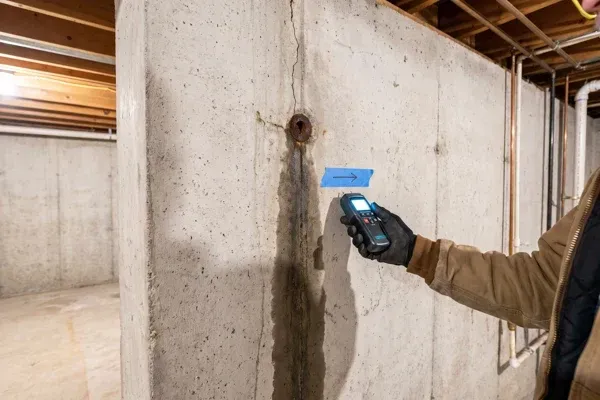
Most basement leaks enter through a few predictable weak points: the joint where the wall meets the floor, cracks in the wall or slab, form-tie holes in poured concrete, window wells, pipe penetrations, and the top of the wall where the house framing sits. Each entry point hints at a different source, so location is your first clue.
North Dakota State University’s extension engineer explains that when footing drainage “does not exist or is not functioning,” water enters “at the connection between the wall and floor and through cracks in the floor,” while wall-crack leaks generally come from water “infiltrating the ground from above” (NDSU Extension, 2023). Put simply, low leaks often mean groundwater and drains. Water leaking through the basement wall higher up often means surface water, grading, and gutters.
Window wells deserve a mention. The University of Minnesota Extension calls them “like a drain right next to the basement wall” (University of Minnesota Extension, 2026), and Virginia’s code requires egress window wells to drain into the foundation drainage system, except on well-drained soils (ICC, 2021 Virginia Residential Code, 2021). See our guide to basement egress window requirements for the well itself.
| Where you see water | Most likely source | How to trace it | Structural flag? |
|---|---|---|---|
| Wall-floor joint or floor cracks | High groundwater; clogged or missing footing drain | Appears after long rains and lingers | If the floor lifts or cracks widen |
| Vertical crack, poured wall | Surface water soaking down beside the wall | Leaks during rain; check the downspout above | If it’s wider at one end or growing |
| Horizontal or stair-step crack, block wall | Saturated soil pushing on the wall | Look for inward lean or shifted courses | Yes, get it assessed |
| Wet spots in a regular grid | Unsealed form ties | Evenly spaced spots on a poured wall | Rarely |
| Around a pipe | Gap at the penetration | Rule out plumbing first | Rarely |
| At a basement window | Window well that doesn’t drain | Water standing in the well after rain | Only if the wall below cracks |
| Top of the wall, running down | Water entering above the foundation (sill, siding, stoop, soil piled too high) | Staining starts at the rim joist | If the sill or framing is soft |
How do you find the source of a basement leak?
Trace it by timing and location. Note when the water appears (during rain, a day later, or all the time), mark exactly where it enters, then look at what sits directly outside that spot. A downspout, a low patch of grade, a window well, or a stoop is usually the first suspect.
Water that appears during a storm and stops soon after usually means surface water finding a fast path. Water that arrives a day or two after soaking rain, then lingers, points toward groundwater at the footing. Water in dry weather points to plumbing or condensation.
Roof water is the usual suspect: a typical 1,200-square-foot roof can shed about 750 gallons in a 1-inch rain (University of Nebraska-Lincoln Extension, 2014). Federal Building America guidance says downspouts should end at least 5 feet from the foundation, or feed an underground system at least 10 feet away (U.S. DOE Building America Solution Center, 2021). How far do yours go?
Then check the grade. The 2021 IRC requires 6 inches of fall in the first 10 feet (ICC, 2021 International Residential Code, 2021), and Maryland adopts it statewide (Maryland Department of Labor, 2026). Settled backfill, raised mulch beds, and tipped patios all undo that slope.
There’s no dry season to wait out, either: Reagan National’s 1991-2020 normals put every month between 2.62 and 4.33 inches of precipitation (National Weather Service, 2024). A hose test, running water at one outside spot while someone watches inside, can confirm a path between storms.
If the trail goes cold, ask BOZ for a leak and foundation assessment. The engineer who does the site visit is the one who designs the fix.
Basement leak repair options, matched to the source
The right basement leak repair depends on where the water comes from, not where it shows up. Surface-water leaks are often solved outside with gutters, downspouts, and grading. Crack and penetration leaks get sealed. Groundwater leaks need drainage, inside or outside the wall, as the table below shows.
| Source | Typical repair | Relative cost |
|---|---|---|
| Downspouts discharging at the wall | Extensions or piping to an approved outlet | Lower |
| Grade sloping toward the house | Regrading; tight lots may need an engineered plan | Lower to moderate |
| Leaking crack that isn’t moving | Polyurethane injection (seals, adds no strength) | Lower to moderate |
| Dormant, dry structural crack | Epoxy injection to rebond | Moderate |
| Pipe penetration or form-tie holes | Seal the gap or tie | Lower |
| Window well | Restore drainage, clean out, add a cover | Lower to moderate |
| High groundwater or failed footing drain | Interior drain and sump, or exterior excavation with drain and membrane | Higher |
The crack distinction matters. The Bureau of Reclamation’s concrete repair guide, written for dams but built on the same material science, says epoxy is used “to structurally rebond cracks that are dormant and relatively dry,” while polyurethanes “seal cracks or joints that leak water,” and “it is usually not possible to structurally rebond cracks that are leaking water” (U.S. Bureau of Reclamation, 2015).
What about sealing from the inside? NDSU notes that under a high water table, water generally “cannot be stopped from entering the basement with products placed inside the basement because of the external water pressure” (NDSU Extension, 2023). Interior drainage works differently: it collects the water and pumps it out.
The code starts with drainage, too: the IRC requires drains around foundations that enclose habitable or usable space below grade, and full waterproofing where “a high water table or other severe soil-water conditions are known to exist” (ICC, 2021 International Residential Code, 2021). Yet UMN notes many existing houses “simply have no subsurface drainage system” (University of Minnesota Extension, 2026). For the bigger decision, see basement waterproofing vs. foundation repair.
When is a basement leak a sign of a structural problem?
When the leak comes with movement. A horizontal crack, stair-step cracking in block, a wall leaning inward, a crack wider than it was last season, or a floor that has lifted all mean something is pushing or settling, not just seeping. Those leaks need a structural assessment before anyone seals them, because sealing can hide the evidence.
The Bureau of Reclamation warns that when cracks are “cyclically opening and closing, or progressively widening, structural repair becomes very complicated” (U.S. Bureau of Reclamation, 2015). Is your crack still moving? Pencil a dated mark at each end; growth past the marks is worth a call. Water also does quiet damage above the foundation. UMN lists “rot and decay of wood headers, joists, sill plates and columns” among the symptoms of chronic basement moisture (University of Minnesota Extension, 2026).
Compare what you’re seeing against our guide to signs of foundation problems. If a wall is leaning in, read what a bowing basement wall means, and if settlement needs support from below, see basement underpinning in the DMV.
Do you need a permit or an engineer to fix a basement leak?
Often you’ll need a permit, and sometimes an engineer. Fairfax County, for example, requires a residential miscellaneous permit for foundation repair, interior drain tile, and interior or exterior waterproofing (Fairfax County Land Development Services, 2026). Rules differ across DC, Maryland, and Virginia jurisdictions, so confirm with your building department before work starts.
Extending a downspout doesn’t call for an engineer. Bracing or rebuilding a wall, underpinning, or reworking drainage around the house often does, and a PE-stamped design gives the permit reviewer and the contractor the same clear scope. See our overview of building permits in DC, Maryland, and Virginia.
Contractors are the right people to install a repair; the engineer’s job comes one step earlier, deciding which repair addresses the cause. Our guide on who to call for water in the basement walks through each trade’s role. When grading is the source, a grading and drainage plan designs the fix before anyone moves soil.
“A lot of the basement leaks I see start outside the house, at a downspout or a low spot in the yard. Seal the crack without fixing that, and the water finds the next way in.” - Koray Bozkurt, PE
Frequently Asked Questions
Can you fix a basement leak from the inside?
You can often manage one from inside, but blocking it from inside is harder. Coatings struggle against soil-side pressure, and NDSU notes that under a high water table, water generally can’t be stopped with products placed inside the basement (NDSU Extension, 2023). Interior drains and sumps collect water instead.
Is a leaking crack in a basement wall serious?
It depends on whether it’s moving. A thin vertical crack that leaks but isn’t growing is usually a sealing job. Horizontal cracks, stair-step cracks, or cracks that keep widening signal movement, which the Bureau of Reclamation says makes structural repair “very complicated” (U.S. Bureau of Reclamation, 2015). Have those assessed first.
Why does my basement only leak when it rains hard?
Heavy rain overwhelms the paths that carry water away. A 1,200-square-foot roof can shed about 750 gallons in a 1-inch rain (University of Nebraska-Lincoln Extension, 2014), concentrated at a few downspouts. If those end near the wall, or the grade slopes inward, the soil against your foundation saturates fast.
How quickly should I deal with a basement leak?
Right away. The EPA says that if wet materials are dried within 24-48 hours of a leak, in most cases mold won’t grow, and advises fixing water problems “as soon as possible” (U.S. EPA, 2026). BOZ is an engineering firm and doesn’t test for or remediate mold. Our role is the water source and any structural damage.
How much does basement leak repair cost?
It ranges widely because the repair depends on the source. Extending a downspout is a small job; excavating a wall to replace a footing drain and membrane is a major one. Get the source diagnosed before collecting bids so every contractor prices the same scope. Our foundation repair cost guide covers the structural end.
Get the source diagnosed before you buy the fix
A good leak assessment answers three questions: where the water comes from, whether it has affected the structure, and which repair fits. BOZ Engineering Group has served the DMV since 2008, and its founder, a licensed Professional Engineer (PE) in DC, Maryland, and Virginia, personally oversees the engineering on every project.
The engineer who does the site visit is the one who designs the fix, from PE-stamped foundation design and repair to engineered grading and drainage plans. For the wider picture, our guide to water in the basement maps every common source.
The bottom line
A leak in the basement is a message about water moving where it shouldn’t, and most leaks trace back to a specific source, often outside the house. Fix the source and the repair has something to hold. Seal only the symptom, and the water often finds another way in.
Start with the simple checks: condensation or leak, timing, downspouts, and grade. If the water keeps coming, or a crack is moving, talk to a BOZ engineer about your basement leak before you pay for a fix.
Koray Bozkurt, PE, PMP is the founder and principal engineer of BOZ Engineering Group, a structural, civil, geotechnical, and MEP engineering firm serving Washington DC, Maryland, Virginia, and Florida since 2008. A licensed Professional Engineer in DC, Maryland, Virginia, and Florida, he is WACEL certified in soil, concrete, foundation inspection, and structural masonry, and personally oversees the engineering on every BOZ project. Learn more about Koray.