Musty Smell in the Basement? When Moisture Turns Structural
By Koray Bozkurt, PE, PMP - Founder & Principal Engineer, BOZ Engineering Group. Last updated October 2026.
A musty smell in the basement is easy to get used to. It’s also one of the earliest signs that moisture is collecting somewhere it shouldn’t. The EPA traces that odor to compounds released by growing mold and says a moldy odor is a reason to investigate (U.S. EPA, 2026).
Mold is the part everyone notices. What matters to an engineer is the water feeding it, and whether that water has reached the sill plates and joists that hold up your house. Here’s where the moisture comes from, how it becomes wood decay, and where a mold job ends and a structural one begins.
Key Takeaways
- A musty basement smell is a moisture signal. The EPA says a moldy odor suggests mold is growing and should be investigated (U.S. EPA, 2026).
- The EPA recommends keeping indoor humidity below 60%, ideally between 30% and 50% (U.S. EPA, 2026).
- Humid air alone rarely rots wood. Serious decay needs wood moisture content above the fiber saturation point, about 30% on average, which takes leaks, condensation or wet ground (USDA Forest Products Laboratory, 2021).
- BOZ is an engineering firm, not a mold company. The engineer’s job is the moisture source and any structural damage.
What Causes a Musty Smell in the Basement?
A musty smell in the basement almost always traces back to moisture. Molds release microbial volatile organic compounds (mVOCs), and the EPA says they can be the source of the musty odor associated with mold growth (U.S. EPA, 2026). Mold needs moisture to grow, so the smell is really telling you where water or damp air is collecting.
Basement moisture comes in two forms that point to different fixes. Liquid water comes from outside or from plumbing: rain running toward the foundation, overflowing gutters, downspouts emptying next to the wall, failed footing drains, cracks and leaking pipes. Water vapor is humid air that condenses on cool concrete, pipes and framing.
The EPA’s list of common moisture problems includes gutters and downspouts that direct water into or under a building (U.S. EPA, 2025). The Department of Energy adds a less obvious source: moisture below the foundation that moves up through the wall by capillary draw (DOE Building America Solution Center, 2022). So which one is yours? If water shows up after storms, start with our guide to water in the basement.
What Is the Ideal Basement Humidity?
The EPA recommends keeping indoor relative humidity below 60%, and ideally between 30% and 50% (U.S. EPA, 2026). Above it, damp air can support mold on surfaces even without a leak, and when warm, humid air meets a cold surface, the EPA notes, condensation may form.
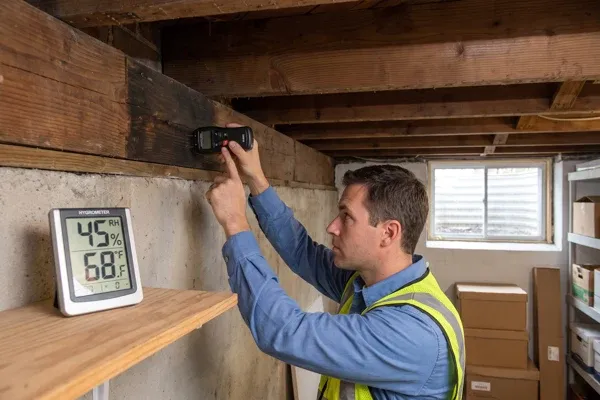
The EPA describes a humidity meter as a small, inexpensive instrument sold at many hardware stores. Leave one in the basement through a summer. Readings above 60% for weeks, or beads of water on cold pipes and walls, mean the air is holding too much moisture.
That’s a real issue in the DMV. The International Residential Code places DC, Montgomery and Prince George’s counties, and most of Virginia in climate zone 4A, where the “A” means moist (ICC, 2021 IRC Table N1101.7, 2021). In warm seasons in humid climates, humid air can leak in around windows and rim joists and condense on cooler surfaces such as floor joists and below-grade walls (DOE Building America Solution Center, 2022).
Leak or Condensation: Reading the Pattern
Timing is the best clue. Moisture that appears during or after heavy rain usually points to liquid water from outside: grading, gutters, drains or cracks. Moisture that builds during long humid stretches, with no link to storms, usually points to condensation. Many basements have both, which is why treating only one can leave the smell behind.
One simple check: tape a piece of foil to the bare wall and look at it after a day or two. Moisture behind the foil means it’s coming through the wall. Condensation on the room side of the foil means it’s coming from the air (National Park Service, 1996).
Location matters too. Staining along the base of the wall suggests water pushing in from outside (see basement leak repair). Damp spots out in the slab point to water coming up through the basement floor. And a smell strongest near a finished wall? The EPA lists the back side of drywall and paneling among the usual places hidden mold grows (U.S. EPA, 2026). That’s also where the framing you need to see is hiding.
Can Basement Moisture Damage Wood Framing?
Yes, but usually not from humid air alone. The Forest Products Laboratory’s Wood Handbook says serious decay occurs only above the fiber saturation point, about 30% moisture content on average, which takes rain, condensation or contact with wet ground. Humid air alone won’t wet wood enough for significant decay, though it can support some mold (USDA Forest Products Laboratory, 2021).
Why does that distinction matter? The same chapter notes that mold and stain fungi ordinarily affect wood strength only slightly, while decay fungi feed on the wood’s structural components. Decay also hides. By the time decay has cost wood 10% of its weight, the handbook says most strength losses can be expected to exceed 50%, and at weight losses that small, decay is detectable only microscopically.
In a basement, the vulnerable spots are predictable: sill plates on the foundation wall, the rim joist beside them, joist and girder ends in masonry pockets, and wood posts on the slab. The handbook also warns that plumbing leaks can cause serious decay, particularly when undetected for long periods.
The code targets the same spots. Section R317.1 of the 2021 IRC requires naturally durable or preservative-treated wood for framing resting directly on exterior foundation walls less than 8 inches above exposed ground, and for girder ends set into exterior concrete or masonry walls with less than 1/2 inch of clearance (ICC, 2021 IRC Section R317.1, 2021). Virginia’s code has been based on the 2021 I-codes since January 18, 2024 (Virginia DHCD, 2024). Maryland requires every jurisdiction to use the same edition of the IRC, with local modifications allowed (Maryland Department of Labor, accessed 2026). DC still enforces its 2017 Construction Codes, built on the 2015 I-codes (DC Department of Buildings, accessed 2026), and began updating them to newer ICC editions in June 2026 (DC Department of Buildings, 2026).
Damaged joists can sometimes be reinforced; see sistering floor joists. Crawl spaces carry the same risks, covered in crawl space repair. Found soft wood at the sill or joist ends? Talk to a licensed PE before anyone covers it up.
Mold Job or Structural Job: Where the Line Falls
Surface mold on drywall or stored boxes is a cleanup job. Water that keeps returning, wood that’s soft or crumbling, and cracks, bowing or settlement are structural and water-source questions. BOZ is an engineering firm and doesn’t do mold testing or remediation. Our role is finding the moisture source and assessing any structural damage.
The EPA says that if the moldy area is less than about 10 square feet, in most cases you can handle the cleanup yourself; larger areas or heavy water damage call for its detailed remediation guidance (U.S. EPA, 2026). The EPA also states that molds produce allergens, irritants and, in some cases, potentially toxic substances. Health questions belong with your doctor, not an engineer.
What decides whether the mold comes back isn’t the cleanup. It’s the water. Clean up the mold without fixing the water problem, the EPA says, and the mold will most likely return (U.S. EPA, 2026).
| What you notice | What it usually points to | Who to call first |
|---|---|---|
| Musty smell, no visible water, humidity above 60% | Condensation | Dehumidifier; engineer if the smell persists |
| Small mold patch (under about 10 sq ft) | Surface mold from damp air or a small leak | Cleanup per EPA guidance, then fix the source |
| Mold across a large area or after major water damage | A sustained moisture problem | Remediation professional, plus an engineer for the source |
| Water or staining after heavy rain | Grading, gutters, downspouts, drains or cracks | Engineer to trace the source |
| Soft, dark or crumbling wood at sills, rim joists or joist ends | Decay from sustained wetting | Structural engineer before any repair |
| Musty smell plus cracks, bowing walls or sagging floors | Water and structural movement together | Structural engineer |
| Wet spot under a pipe or fixture | Plumbing leak | Plumber; engineer if framing stayed wet a long time |
Not sure which trade comes first? See who to call for water in the basement.
When Should You Call a Structural Engineer About a Musty Basement?
Call an engineer when the smell outlasts the fixes that should have worked, or when the evidence points past the air: water after storms, a smell that persists with humidity under control, soft or stained framing, cracks or bowing walls, or sagging floors above. Each suggests a water source or structural damage that a dehumidifier won’t address.
On a site visit, the engineer works from the outside in. The EPA’s own moisture advice includes making sure the ground slopes away from the foundation so water doesn’t collect around it (U.S. EPA, 2026). From there: gutters and downspouts, footing drains, the walls and slab, then the framing itself.
“Water usually gets into a basement where nobody is looking, and it sits there. The musty smell is often the first thing anyone notices. Find the source before you pay to treat what it left behind.” - Koray Bozkurt, PE
The result is a diagnosis and, where needed, a repair design: a PE-stamped grading and drainage plan for water pooling against the house, a foundation repair design for cracked or failing walls, or a repair design for decayed framing. See also foundation drainage, backyard drainage solutions, and the signs of foundation problems, including bowing basement walls.
Frequently Asked Questions
Is a musty smell in the basement always mold?
Not always, but treat it as a moisture warning. The EPA’s investigation guidance says damp or musty odors suggest water is or was present and mold growth is likely (U.S. EPA, 2025). Even without visible growth, moisture is collecting somewhere, often behind finished walls or under carpet.
What humidity should a basement be kept at?
The EPA recommends keeping indoor relative humidity below 60%, ideally between 30% and 50% (U.S. EPA, 2026). Measure it over several weeks, especially in summer. If a dehumidifier can’t hold the space under 60%, or the smell persists when it does, look for liquid water getting in.
Can a dehumidifier fix a musty basement?
It treats the air, not the source. The DOE’s guidance for a musty basement is to find the moisture sources first, reduce how fast moisture gets in, then run a dehumidifier (DOE Building America Solution Center, accessed 2026). If water is entering from outside, drying the air only manages the symptom.
Does mold in the basement mean my foundation is failing?
No. Mold tells you about moisture, not foundation strength; what matters is where that moisture goes. The Wood Handbook says serious decay needs wood moisture content above about 30%, which takes leaks, condensation or wet ground rather than humid air alone (USDA Forest Products Laboratory, 2021). An engineer can check the framing and foundation.
Does BOZ Engineering test for or remove mold?
No. BOZ is an engineering firm and doesn’t do mold testing or remediation. The EPA says that in most cases, if mold growth is visible, sampling is unnecessary (U.S. EPA, 2026). Our role is finding where the moisture comes from, assessing any structural damage, and designing a repair that addresses the cause.
Get the Moisture Source Diagnosed
Still smelling it after the usual fixes? The next step is an engineer’s assessment of where the water comes from. Koray Bozkurt is a licensed Professional Engineer (PE) in DC, Maryland, and Virginia, and BOZ has served the DMV since 2008. The engineer who does the site visit is the one who designs the fix. Contact BOZ Engineering to schedule an assessment, or first read what drives structural engineer cost.
Conclusion
A musty smell is the basement telling you moisture is present. Sometimes it’s humid air a dehumidifier can handle. Sometimes it’s water that has already reached the wood carrying your floors. Cleaning up mold without finding the source only resets the clock.
So find that source before anyone sells you a fix. Start with our foundation design and repair services, where a licensed PE traces the water and designs a repair aimed at the root cause.
Koray Bozkurt, PE, PMP is the founder and principal engineer of BOZ Engineering Group, a structural, civil, geotechnical, and MEP engineering firm serving Washington DC, Maryland, Virginia, and Florida since 2008. A licensed Professional Engineer in DC, Maryland, Virginia, and Florida, he is WACEL certified in soil, concrete, foundation inspection, and structural masonry, and personally oversees the engineering on every BOZ project. Learn more about Koray.