
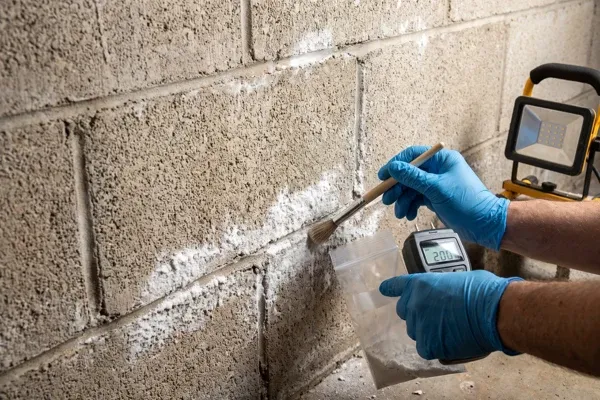
Efflorescence on Basement Walls: What the White Powder Means
By Koray Bozkurt, PE, PMP - Founder & Principal Engineer, BOZ Engineering Group. Last updated October 2026.
That white, chalky powder on your basement wall has a name: efflorescence. It’s salt. Concrete, block, brick and mortar carry soluble salts, and when water moves through the wall and evaporates on your side, it leaves them behind as a deposit you can usually brush away. The deposit is mostly harmless. What it tells you isn’t.
Almost every patch of efflorescence on basement walls is a record of water that got into the wall, crossed it and dried at the surface. Here’s how to tell it from mold, read its pattern, clean it without harming the masonry, and know when it deserves an engineer’s visit.
Key Takeaways
- Efflorescence is a deposit of soluble salts, usually white, left when water moving through concrete or masonry evaporates. It needs salts, moisture and a force moving that moisture; remove any one and it won’t form (CMHA, 2024).
- The surface deposit itself “will not affect structural performance” (CMHA, 2024). The water behind it can, starting with salts crystallizing inside the masonry and spalling the surface (National Park Service, 2000).
- The pattern is evidence. A level band low on the wall suggests wicking from below, white lines along a crack mark a leak path, and deposits that return after cleaning mean an active source.
- Brush it off dry, skip the sealers, and fix the water source first, usually starting outside with grading and downspouts.
What is efflorescence on basement walls?
Efflorescence is a crystalline salt deposit, usually white, that forms when water dissolves soluble compounds in concrete, block, brick or mortar, carries them to the surface and evaporates. The Concrete Masonry & Hardscapes Association (CMHA) says it takes three things at once: soluble compounds, moisture to carry them, and evaporation or hydrostatic pressure to move the solution (CMHA, 2024).
Basements add a salt source of their own: CMHA notes that masonry in contact with soil can absorb groundwater containing salts, which capillary action can draw several feet up the wall. Age matters too. A light, even bloom on a new wall is often construction moisture leaving the materials (“new building bloom”). Heavy or recurring deposits on an older wall are different. CMHA says that kind “indicates a need for corrective measures” (CMHA, 2024).
Is it efflorescence or mold?
Color won’t settle it. The EPA notes that molds come in many colors and shows white mold alongside black (EPA, 2026). Efflorescence is a mineral deposit: it usually looks crystalline or powdery and sits on bare concrete or masonry. Because most efflorescing salts are water soluble (CMHA, 2024), a light deposit often dissolves when dampened.
Mold is a living growth, and EPA’s photos show it on wallpaper, ceiling tile and a suitcase stored in a humid basement. EPA is also clear that no mold grows without water or moisture, so finding both can point to the same water problem.
To be plain: BOZ is an engineering firm, and we don’t do mold testing or mold remediation. If you suspect mold, follow EPA’s guidance or hire a mold professional. We find the moisture source and assess any structural damage. EPA also advises keeping indoor humidity below 60 percent, ideally 30 to 50 percent (EPA, 2026).
Where is the water coming from?
Usually from outside, and from a short list of suspects that our water in the basement guide maps in detail: surface water that isn’t carried away from the foundation, roof water dumped next to the wall, clogged or failed footing drains, an aged-out exterior wall coating, or groundwater that rises seasonally. The deposit’s pattern is one of the best clues.
The DMV gives water plenty of chances. Reagan National averages 41.82 inches of precipitation a year (1991-2020 normals) (NOAA NCEI, 2021), and the Northern Virginia Soil and Water Conservation District notes that clay-rich soils drain poorly and that Virginia groundwater tables tend to peak in February and March (NVSWCD, 2022). CMHA adds that efflorescence is more common in winter, when evaporation is slower. Noticing more powder in late winter? Those two facts are a likely reason.
Virginia’s 2021 Residential Code sets the baseline for new homes: grade falling at least 6 inches within the first 10 feet of the foundation (R401.3), drains around foundations enclosing habitable or usable space below grade (R405.1), and dampproofing, or waterproofing where a high water table is known (R406) (ICC, 2021 Virginia Residential Code, 2021). Maryland requires every jurisdiction to use the same edition of the IRC, with local modifications allowed (Maryland Department of Labor, 2026), DC enforces its own construction codes, and many older DMV houses predate all of them. Outside, see what a grading plan is and backyard drainage solutions.
A quick check from the National Park Service: tape foil to the wall for a day or two. Moisture behind it is coming through the masonry, while condensation on its face is from the air (National Park Service, 1996). Then read the pattern as a clue, not a diagnosis:
| What you see | What it usually points to | What to check first |
|---|---|---|
| Heavy streaks below mortar joints, or one localized patch | Water entering the wall higher up | Grading, downspouts, window wells above it |
| Fairly level horizontal band low on the wall | Capillary rise (“rising damp”) from wet soil or groundwater | Groundwater level, footing drains |
| White lines tracing a crack | The crack is the water’s path | Crack width, direction, and whether it’s growing |
| Deposits along the wall-floor joint | Water at footing level, possible pressure under the slab | Footing drains, sump, surface drainage |
| Powder with flaking or pitted masonry | Salts crystallizing inside the wall (subflorescence) | Wall condition, any coating trapping moisture |
| Deposits that return after cleaning | An active, ongoing water source | A full source investigation |
CMHA ties streaks below mortar joints to water entering higher up, the NPS describes the rising-damp band as a “tide mark” about 1 to 3 feet above grade (National Park Service, 1996), and NVSWCD links water at the wall-floor joint to pressure beneath the floor (NVSWCD, 2022). For crack leaks, see basement leak repair; for the slab, see basement floor seeping water.
Is efflorescence in a basement a structural problem?
Not by itself. CMHA states that efflorescence will not affect structural performance (CMHA, 2024). The structural question is about the water, not the powder on the surface. Moisture that keeps moving through a foundation can damage the masonry and the wood sitting on it, so read the powder as an early warning.
An engineer looks for three damage paths. First, salts crystallizing just beneath the surface (subflorescence) can make masonry spall, especially behind a water-repellent coating that slows drying (National Park Service, 2000). Second, moisture rising in saturated foundation walls can “eventually cause deterioration of the masonry and adjacent wooden structural elements” (National Park Service, 1996).
In most houses, that wood is the sill plate and the joist ends, the territory of sistering floor joists. Third, soil kept saturated against a wall pushes harder on it, which is how a water problem becomes a bowing basement wall.
“Efflorescence is the wall’s record of water moving through it. Brushing the salt off is easy. The real job is finding where that water got in and what it has done to the wall on the way through.” - Koray Bozkurt, PE
Seeing salt with cracks, flaking masonry or damp wood? That combination is worth a site visit, so talk to the engineer who does the work before anyone quotes a repair.
How do you remove efflorescence without making it worse?
Dry first. CMHA says most efflorescence comes off by dry brushing followed by a clean-water flush, but it also warns that washing puts more water into the wall and can promote more efflorescence (CMHA, 2024). A stiff brush and a shop vacuum usually handle a light deposit.
The NPS recommends non-metallic bristle brushes (National Park Service, 1996). CMHA treats dilute muriatic acid as a last resort, and the NPS says it shouldn’t be used on historic masonry because it can dissolve lime-based mortar (National Park Service, 2000). In an older DMV basement, skip it.
Don’t seal over active efflorescence either. CMHA warns that clear water-repellent coatings on a wall prone to it, applied without reducing the causes, may lead to surface spalling. A coating doesn’t stop the water. It can shift where the water evaporates, sometimes to inside the masonry.
Order matters most. CMHA says to establish the cause and repair it before removing the deposit, and the NPS advises handling ground moisture before excavating or adding dampproofing and footing drains. Foundation drainage and interior vs. exterior basement waterproofing cover the next layer. Where the fix is on the lot, BOZ produces PE-stamped grading and drainage plans.
When should an engineer look at efflorescence?
When it comes with company. A light deposit that doesn’t return can usually be watched. Efflorescence that keeps coming back, or appears with cracks, bowing, spalling, water at the wall-floor joint or soft wood at the sill, deserves a professional assessment before anyone sells you a fix.
On a site visit, we read the deposit pattern, check grading and drainage outside, inspect the wall and the framing it supports, and trace the water to its source. Then we design the repair: PE-stamped foundation design and repair engineering, an engineered grading and drainage plan, or both. Your contractor builds from that design. Unsure who to call first? See who to call for water in the basement.
Frequently Asked Questions
Is efflorescence a sign of foundation problems?
It’s a sign of moisture, not proof of damage. CMHA says efflorescence itself will not affect structural performance (CMHA, 2024). But the water behind it can spall masonry, deteriorate the wood on top of the wall and add pressure against it. Efflorescence alongside cracks, bowing or other signs of foundation problems is worth an engineer’s assessment.
Does efflorescence mean I need basement waterproofing?
Not automatically. The NPS advises handling ground moisture first, meaning grading, downspout discharge and splash-back, before excavating or adding dampproof coatings and footing drains (National Park Service, 1996). NVSWCD notes that extending roof drainage outlets 6 or more feet beyond the foundation often can prevent or correct a wet basement (NVSWCD, 2022).
Will efflorescence come back after I clean it?
It will if the water keeps moving, because cleaning removes the salt, not the source. CMHA says recurring efflorescence “indicates a need for corrective measures” and notes deposits are more common in winter, when slower evaporation lets salts reach the surface (CMHA, 2024). A deposit that returns points to an active leak path.
Can I seal over efflorescence?
Not until the source is fixed. CMHA warns that clear water-repellent coatings on a wall prone to efflorescence, applied without reducing its causes, may lead to surface spalling (CMHA, 2024). The NPS adds that water repellents can be especially damaging on masonry containing salts, because they limit the flow of moisture. Fix the water first.
Should efflorescence worry me when buying a house?
It’s worth answering before closing. Efflorescence proves water has moved through the foundation at some point, and the seller may not know why. A structural inspection before buying a house can check the pattern, the grading and the framing, so you know whether you’re buying a stain or a repair.
Have the source traced before you pay for a fix
BOZ Engineering Group has served the DMV since 2008, and the engineer who does the site visit is the one who designs the fix. Koray Bozkurt is a licensed Professional Engineer (PE) in DC, Maryland and Virginia. If white powder keeps returning on your basement walls, schedule a consultation for an independent read on the water’s source.
The bottom line on basement efflorescence
Efflorescence is one of the gentlest warnings a foundation gives. The salt brushes off, but it proves water is moving through the masonry, and its pattern shows roughly where that water came from. Clean it dry, skip sealers and acid, and start outside.
If it keeps returning, or shows up with cracks, flaking or damp wood, the next step is an engineer’s assessment of the source and any damage. See how we approach foundation design and repair across DC, Maryland and Virginia.
Koray Bozkurt, PE, PMP is the founder and principal engineer of BOZ Engineering Group, a structural, civil, geotechnical, and MEP engineering firm serving Washington DC, Maryland, Virginia, and Florida since 2008. A licensed Professional Engineer in DC, Maryland, Virginia, and Florida, he is WACEL certified in soil, concrete, foundation inspection, and structural masonry, and personally oversees the engineering on every BOZ project. Learn more about Koray.